Applying for a Switzerland visa from Nigeria requires precision in 2026 – the same thing the Swiss are famous for.
How to Apply for a Switzerland Visa in Nigeria (Tourist, Visit & Business)
Let’s not pretend otherwise.
Switzerland is one of the most expensive countries on the planet. A coffee in Zurich costs what a full meal costs in Lagos. A train journey between two cities that are forty minutes apart will make you briefly reconsider your life decisions. Hotel rooms in Geneva during conference season are priced with a confidence that suggests the Swiss have done the market research and concluded that people will pay anything, and they are correct.
None of this has stopped Nigerian travellers from going. If anything, the expense has become part of the appeal – proof that you planned for it, saved for it, and decided it was worth it. And overwhelmingly, the people who go to Switzerland report that it was.
Here is what’s surprising, though: Switzerland is not a member of the European Union. It is not an EU country, has never joined despite sharing borders with four EU nations, and has actively voted against membership in a 1992 referendum that still stands. Yet it is a full member of the Schengen Area, which means the visa process runs through the same Schengen framework as France, Germany, and Italy.
This distinction matters, because it shapes which consulate processes your application, which rules apply, and what a Nigerian passport holder actually needs to organise before they arrive at the VFS submission centre.
There is something about Switzerland that feels like stepping into another world – snow-capped mountains, pristine lakes, chocolate shops, and the quiet efficiency that characterises everything from the trains to the public toilets. Adaeze, a finance professional from Abuja, applied for a Switzerland visa for a business conference in Geneva. She was meticulous with her documents, submitted 7 weeks early, and received her visa within 15 days. ‘Switzerland is strict,’ she later said, ‘but completely fair. Prepare well, and it rewards you.’
What Makes Switzerland Worth the Budget Planning
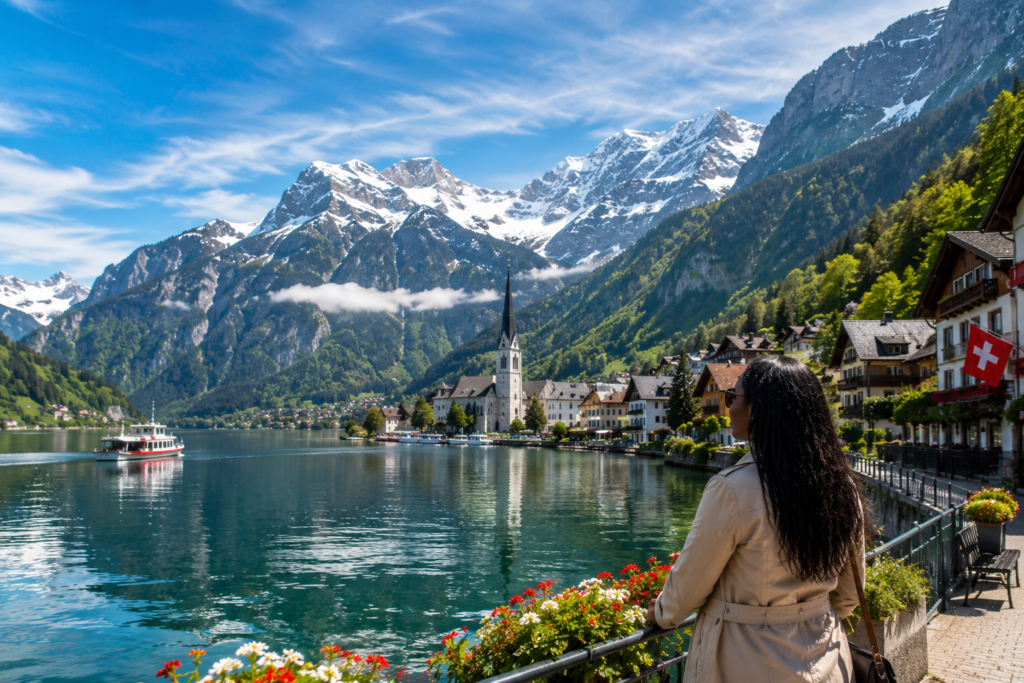
The Alps are the obvious answer, and they deserve the reputation. The Matterhorn above Zermatt is one of the most recognisable mountain profiles in the world for good reason — there is nothing that prepares you for the scale of it in person, the way it dominates the skyline so completely that the town below it feels like an afterthought. In winter the skiing draws enthusiasts who regard the Swiss Alps as the benchmark against which all other mountain resorts are measured. In summer the same terrain becomes hiking country, with trails winding through valleys that feel as though they have been maintained specifically to make you feel small in the best possible way.
But Switzerland is not only mountains.
Zurich is consistently ranked among the top five most liveable cities on earth and has a cultural life — museums, galleries, theatre, a music scene that punches well above its size — that surprises most visitors who arrived expecting a banking hub and found a genuinely interesting city instead. Geneva hosts more international organisations per square kilometre than anywhere else in the world: the United Nations, the Red Cross, the World Health Organization, CERN — which is where the World Wide Web was invented, a fact that deserves a brief pause. Lausanne sits on the shores of Lake Geneva with a scale and a pace that makes it feel more like a large village than a city, which is intended as the highest possible compliment.
Then there is Lucerne, which is what every European city wishes it looked like: a medieval wooden bridge crossing a river, mountains behind it, swans in the water, and a clocktower that has been functioning reliably since the 14th century. It is almost aggressively picturesque, but in a way that is entirely genuine rather than manufactured.
For Nigerian travellers, Switzerland represents something specific: a destination that requires real planning and real financial commitment, and returns both in full.
Now, the application process.
A Key Fact Before You Start: Switzerland Uses Its Own Visa System
Switzerland is in Schengen but not the EU. This means Swiss visa applications are handled by Swiss authorities using the Schengen framework but Switzerland processes its own applications independently rather than deferring to an EU member state’s consulate.
In practical terms for Nigerian applicants: your Switzerland Schengen visa application is submitted through VFS Global, which acts as the authorised processing partner for the Swiss Embassy in Nigeria. The submission centres are in Lagos and Abuja.
One operational difference worth knowing: Switzerland is not part of VFS’s standard multi-country platform in the same way as some other Schengen nations. Use the Switzerland-specific portal on the VFS Global website to access the correct checklist, application form, and appointment booking system. Requirements are updated periodically, and using an outdated guide as your sole reference is how avoidable mistakes happen.
Why Nigeria Travellers Choose Switzerland
Switzerland is not a European Union member, but it is part of the Schengen Area meaning your Switzerland visa allows you to travel freely across all 29 Schengen countries. Switzerland is home to the Swiss Alps, Geneva’s international organisations, Zurich’s world-class banking sector, and some of the world’s most beautiful scenic rail journeys. Whether for tourism or business, it is a destination unlike any other.
- The Swiss Alps — Zermatt, Jungfraujoch, Verbier, and Grindelwald are world-class alpine destinations
- Geneva — home to the UN, ICRC, WHO, WTO, and over 200 international organisations
- Zurich — one of the world’s premier banking and finance centres
- The Glacier Express — consistently ranked among the world’s most scenic railway journeys
- Swiss chocolates, watches, and cheese — cultural exports that have conquered every continent
- Business meetings at Davos (WEF), Basel Art Fair, and Geneva’s international conferences
Switzerland Visa Types for Nigerian Applicants
Schengen Type C — Short Stay
Stays of up to 90 days within any 180-day period. This covers tourism, family visits, business meetings, conference attendance, medical travel, and short academic programmes. Available as single, double, or multiple-entry depending on your application profile. This is the relevant category for the majority of Nigerian travellers.
National Type D — Long Stay
For stays beyond 90 days. Students enrolled in Swiss institutions, individuals relocating for work, and those pursuing residency permits apply in this category. Significantly more documentation is required and the process differs substantially. This guide focuses on Type C.
The Complete Document Checklist With Explanation
A list alone is not enough. Here is what each document accomplishes from the reviewer’s perspective.
Passport
Valid for at least three months after your final day in Switzerland, with a minimum of two blank pages for entry stamps. If your passport’s validity or available pages are insufficient, renew before beginning your application. The Swiss Embassy will not accommodate exceptions.
Schengen visa application form
The current version, completed in full, signed, and dated. Download this from the VFS Global Switzerland portal. Verify you are using the current version — older forms from third-party websites cause submission complications. Every field must contain an answer. Blank spaces signal carelessness to a reviewing officer.
Biometric photographs
Two recent photographs, 35mm by 45mm, against a plain white background, taken within the past six months. Go to a professional photographer. The specifications are exact and a technically rejected photograph wastes your appointment.
Schengen-compliant travel insurance
Minimum €30,000 coverage in medical expenses and emergency repatriation, valid across every Schengen member state for the complete duration of your stay. Switzerland is known for having some of the highest medical costs in Europe — the minimum coverage requirement is not excessive in this context. Read the policy document carefully before purchasing. Some lower-cost products have exclusions or territorial limitations that render them non-compliant. An invalid insurance certificate is indistinguishable from no certificate at all.
Flight itinerary
Round-trip travel dates showing your proposed arrival into Switzerland and departure back to Nigeria. A provisional booking issued by a travel agent — not a paid, non-refundable ticket — is the accepted and recommended approach. Non-refundable flights purchased before a visa decision is received represent financial exposure with no corresponding benefit.
Accommodation confirmation
Evidence of where you will stay for every night of your trip. Hotel reservations, confirmed apartment bookings, or a formal invitation letter from a host in Switzerland supported by their identification and proof of address. Every night of your planned stay must be documented.
Bank statements
Three to six months of statements from your primary bank account. Switzerland’s cost of living is among the highest in the world, and the financial benchmark applied reflects this — approximately €100 per day of your stay is the general working figure, though individual officers have discretion to assess the full picture of your financial circumstances.
What matters most is not the closing balance on your most recent statement. It is the story your account tells over the preceding months: consistent income, proportionate spending, and a balance that credibly supports the cost of this particular trip without apparent financial strain.
Unusual account activity — a large, unexplained deposit appearing two to four weeks before your application submission — consistently raises questions during review. If your account received significant funds for a legitimate reason in the period immediately before application, include documentation that explains it. A client invoice, a business transfer record, a dividend confirmation. The document converts an ambiguity into a clear and verifiable fact.
Employment and income documentation
For employed applicants: an employer’s letter on official company letterhead, confirming your job title, your monthly salary, and your approved leave dates for the travel period. Three to six months of payslips alongside it.
For business owners: your CAC registration certificate, business bank statements covering three to six months, and a letter on your business letterhead describing the purpose of your trip and explicitly confirming your intention to return to Nigeria.
For students: a current enrolment letter and documentation of financial support, whether personal savings, parental sponsorship, or institutional funding.
Cover letter
The document that transforms a collection of paperwork into a coherent application.
Your cover letter is the narrative layer of your submission. It should explain who you are, why you are going to Switzerland specifically, what you plan to do during your stay, where you will sleep, how you are funding the trip, and what awaits you in Nigeria when you return. Write it yourself, specifically, for this application.
The officer reviewing your file has read thousands of applications. Template language, copied from the same online resources everyone uses, is identifiable immediately. A letter that sounds like a person — specific in its details, honest in its reasoning, clear about what you are returning to – performs better than any template regardless of how many stars that template has in the Google search results.
Step-by-Step: How to Apply for a Switzerland Visa from Nigeria
Step 1: Identify the right submission centre
VFS Global handles Swiss Schengen applications in Nigeria. Use the Switzerland-specific section of the VFS website — not the general Schengen portal — to access current requirements, book your appointment, and download the correct application form.
Step 2: Book your appointment early
Switzerland recommends applying 8 weeks before your travel date. Given appointment availability and document preparation time, 10 to 12 weeks is more realistic. Book your slot before your documents are complete to establish a working deadline.
Step 3: Prepare your documents
Assemble everything on the official checklist. Organise it in the specified order. Include an index page at the front. If a document’s relevance is ambiguous, include it — the cost of an unnecessary page is nothing; the cost of a missing one is your application.
Step 4: Attend your biometric appointment
Fingerprints and a digital photograph are collected at the VFS centre. Mandatory for first-time Schengen applicants and those whose biometric data is more than five years old. This step cannot be delegated.
Step 5: Pay your fees
The standard Schengen consular fee is €80 for adults. Children under 6 are exempt. Children aged 6 to 12 pay €40. VFS charges a separate service fee. All fees are paid at the centre on appointment day. None are refunded if the application is refused.
Step 6: Track your application
Processing typically takes 10 working days. Use the VFS tracking system and remain accessible for contact should the embassy request additional documentation. Do not purchase non-refundable travel arrangements while waiting.
A Switzerland Schengen visa from Nigeria typically takes 15 calendar days to process at the Swiss Embassy in Abuja. The embassy recommends applying at least 8 weeks before travel. Processing can be extended for complex cases. The embassy does not accept walk-in applications – appointments are mandatory.
Purpose-Specific Documents
Tourism: A named, day-by-day itinerary. “Zurich on days one and two, day trip to Lucerne on day three, train to Zermatt on day four and five for Matterhorn views, Geneva on days six and seven before departure.” That is a plan. “I intend to travel around Switzerland and enjoy the scenery” is the absence of a plan.
Business: A formal invitation letter from your Swiss host organisation on company letterhead, naming you by full name, describing the specific nature of the engagement and its dates, and confirming who bears your expenses while you are in Switzerland.
Conferences or academic events: Official registration confirmation or acceptance letter from the host institution.
Visiting family or friends: A signed, dated invitation letter from your contact in Switzerland, alongside copies of their Swiss residence permit or passport and documentary evidence of their current address.
Switzerland Visa Fees for Nigerians
| Applicant Category | Visa Fee | Notes |
|---|---|---|
Adults (12 years and above) |
€90 |
Payable in Naira at official embassy rate. Non-refundable |
Children (6–11 years) |
€45 |
Non-refundable |
Children (under 6 years) |
Free |
Application form still required |
Biometrics |
Included |
Stored for 59 months |
Tips for a Successful Switzerland Visa Application
- Switzerland is known for thoroughness – treat every document as equally important. A weak cover letter can undermine an otherwise strong financial file.
- Your travel insurance must cover at least €30,000 AND extend at least 2 days beyond your planned return – a Switzerland-specific requirement.
- Biometric data is stored for 59 months. If you’ve applied within that period, you may not need to re-provide fingerprints.
- Do not book non-refundable flights before your visa is confirmed.
- Prior Schengen visa history is one of the strongest positive signals, include it prominently.
- Apply at least 8 weeks in advance, the embassy itself recommends this.
Switzerland vs VFS Global Countries — What Makes Switzerland Different
| Factor | Switzerland | Most Other Schengen Countries |
|---|---|---|
Application Route |
Directly at Swiss Embassy Abuja |
Via VFS Global / BLS International |
Appointment Booking |
Contact embassy directly |
Book via VFS/BLS online portal |
Walk-ins Accepted? |
No — appointment mandatory |
No — appointment mandatory |
Recommended Lead Time |
8 weeks |
6–8 weeks |
Processing Time |
~15 calendar days |
~15 calendar days |
Visa Fee |
€90 |
€90 |
The Correct Order of Preparation
- Confirm your passport validity and blank pages. Renew before anything else if necessary.
- Book your VFS appointment to create a concrete deadline.
- Begin gathering financial documents — they require the most lead time.
- Purchase Schengen-compliant travel insurance with sufficient coverage for Swiss medical costs.
- Request a provisional flight itinerary from a travel agent. Pay for nothing non-refundable yet.
- Arrange refundable accommodation or obtain a formal invitation letter from your Swiss host.
- Write your cover letter last, when all other documents are assembled.
- Submit your complete, organised package. Track it. Wait for a decision before committing to non-refundable travel costs.
Switzerland Rewards Every Effort
The applications that succeed share a common quality: they read as genuine. Not because they’re perfect — perfection is not the standard — but because the documents are consistent, the financial picture is credible, and there is a specific, believable reason for the trip written clearly in a cover letter that sounds like an actual person composed it.
The applications that fail almost always fall into identifiable patterns.
Missing documents. Every item on the checklist is there because an officer expects to see it. A single missing piece can halt the entire process.
Staged financials. A bank account that shows unusual activity in the two weeks before submission without documentary explanation is a red flag that the rest of the application cannot offset.
No credible ties to Nigeria. The embassy is assessing whether you will leave Switzerland when your visa expires. If your file contains nothing that constitutes a compelling reason to return — no formal employment, no business, no dependants, no significant assets — your application carries higher perceived risk. Your cover letter is the place to address this directly and specifically.
Inconsistency across documents. Every document in your package should tell exactly the same story. The same employer name. The same home address. The same salary figure. Any discrepancy between two documents that reference the same fact creates a question the rest of your package may not be able to answer.
Frequently Asked Questions — Switzerland Visa Nigeria
Do Nigerians need a visa to visit Switzerland?
Where do Nigerians apply for a Switzerland visa?
Is Switzerland expensive to visit from Nigeria?
Can I travel to France or Germany with a Switzerland Schengen visa?
What is the best time to visit Switzerland?
What if the Swiss Embassy rejects my visa?
Start Your Switzerland Journey Today
Switzerland is waiting and so are our visa experts. At Mr Schengen Visa, we’ve helped hundreds of Nigerians secure their Schengen visas with confidence.
Let us take the stress out of your visa application. Book a Free Consultation |
  Download Your Switzerland Visa Checklist
Address: KM 4 Gbongan – Ibadan Rd, opposite Sterling Bank, Osogbo 230284, Osun, Nigeria.
Phone: +234 816 237 7613 | Email: mrschengenvisa@gmail.com