Applying for a Lithuania visa from Nigeria is entirely within reach in 2026
How to Apply for a Lithuania Visa in Nigeria (Tourist, Visit & Business)
Vilnius is a city that stops people mid-sentence. The old town – a UNESCO World Heritage Site and one of the largest and best-preserved medieval old towns in Northern Europe has a gravitational pull that few European capitals can match. Lithuania also offers the Curonian Spit (another UNESCO site), the Hill of Crosses, and a craft beer and food scene that has quietly become one of Europe’s best-kept secrets.
For Nigerian passport holders ready to discover it, a Lithuania visa is the essential first step. Lithuania has been a full Schengen Area member since 2007, which means a valid Lithuanian visa grants you access to all 27 Schengen countries. One application, one approval, one whole continent of possibilities.
Lithuania is the largest of the three Baltic states by both area and population, which tells you something about the scale being discussed — it has approximately 2.8 million people and covers territory roughly the size of West Virginia. It sits on the eastern Baltic Sea coast, sharing borders with Latvia to the north, Belarus to the east, Poland and the Russian exclave of Kaliningrad to the south.
It is not, for the record, Latvia. The two are frequently conflated and the Lithuanians have opinions about this.
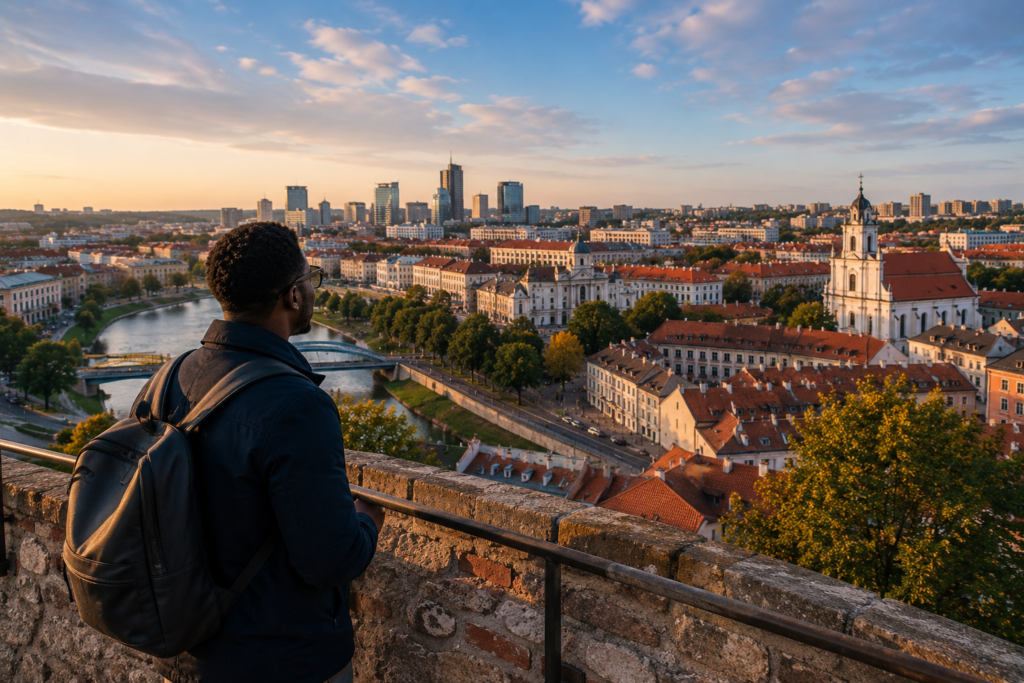
What Lithuania has is Vilnius — a capital city whose old town is a UNESCO World Heritage Site of baroque architecture so dense and well-preserved that it is regularly described as the largest surviving medieval old town in northern Europe. The Vilnius Old Town covers 3.6 square kilometres of narrow streets, courtyards, churches, universities, and cafes that operate under the apparent belief that it is always slightly appropriate to be drinking coffee at any hour of the day.
Vilnius University was founded in 1579. The main library has been in continuous operation for over 400 years.
Then there is the Hill of Crosses — and this is where Lithuania’s wit reveals its deeper roots. The Hill of Crosses is a pilgrimage site in northern Lithuania where visitors have been planting crosses since the 19th century, initially as memorials to those who died in uprisings against Russian imperial rule. Over the Soviet occupation, the authorities bulldozed the site. Completely. Multiple times. Each time, Lithuanians came back and planted more crosses than before. The Soviets gave up. Today the hill holds over 100,000 crosses of every size, material, and style, many of them brought by pilgrims from across the world. Pope John Paul II visited in 1993 and called it “a place of hope.”
A country that rebuilds its symbols faster than occupying powers can destroy them has a particular kind of resilience. And Trakai Island Castle — a 14th-century Gothic fortress sitting on a lake island thirty kilometres outside Vilnius, accessible only by wooden bridge — is the kind of sight that people who have been to fifty European countries still list as one of the most visually striking they have encountered.
The Curonian Spit, shared between Lithuania and Russia’s Kaliningrad exclave, is a narrow strip of sand dunes, pine forest, and fishing villages stretching along the Baltic coast. Also UNESCO-listed. Thomas Mann once had a summer house there, which puts it in the company of places where serious thinkers went to think seriously.
Lithuania was the first Soviet republic to formally declare independence, in March 1990. It did so knowing that Soviet tanks were stationed on its territory and that economic blockades would follow. The independence vote passed. The tanks arrived. The Lithuanians did not back down.
A country with a neighbourhood that jokes about independence and a national history of defying actual empire – this is the level of cultural complexity you are preparing paperwork to visit.
This guide gives you the complete, up-to-date picture – every document you need, exactly where to apply, what the officers are looking for, and how the team at Mr. Schengen Visa can help you get it right first time.
Segun, a Lagos-based software developer, was invited to a tech conference in Vilnius. Lithuania was not on his radar as a travel destination until he started researching it. He found a city with cobblestone streets, baroque churches, and a startup ecosystem so vibrant it is called the ‘Silicon Valley of the Baltics.’ The visa process was straightforward – handled through VFS Global and he received his visa with enough time to add a long weekend in the Lithuanian countryside to his trip. ‘Don’t sleep on Lithuania,’ he told his team when he returned.
About Lithuania and the Schengen Area
Lithuania is the largest of the three Baltic states and a proud Schengen member. Vilnius – the capital, is a UNESCO World Heritage city filled with baroque architecture, medieval charm, and a dynamic modern economy. Lithuania is also known as a growing hub for fintech and technology startups.
A Lithuania Schengen visa grants you access to all 29 Schengen countries for up to 90 days.
What Is the Lithuania Schengen Visa?
A Lithuania Schengen visa is a short-stay travel authorisation that permits Nigerian passport holders to enter Lithuania and the wider Schengen Area for up to 90 days within any 180-day period. It covers tourism, family visits, and business travel. The standard adult fee is €80. Applications are processed through the designated Lithuanian Embassy, as Lithuania has no resident embassy in Nigeria.
Visa Types for Nigerians
Lithuania joined the Schengen Area in 2007. Your Lithuanian entry permit is therefore a Schengen visa — the same document that opens 27 European countries. Approval in Vilnius is approval at every border in the zone.
Schengen Type C — Short Stay
For visits up to 90 days within any 180-day window. This covers tourism, family and friend visits, business travel, conference attendance, medical appointments, and short study programmes. Issued as single, double, or multiple-entry depending on your travel history and circumstances. This is the relevant category for the overwhelming majority of Nigerian applicants.
National Long-Stay Visa (Type D)
For stays exceeding 90 days — enrolled students, workers on assignment, those beginning residency processes. Substantially more complex, different documentation. This guide addresses Type C.
Where to Apply for a Lithuania Schengen Visa from Nigeria
Like Latvia, Lithuania does not maintain a resident embassy in Nigeria. This is one of the most important practical facts for Nigerian applicants to understand before they begin preparing documents.
Applications are typically directed to the Lithuanian Embassy in an accredited EU country — most commonly Berlin (Germany), Warsaw (Poland), or Brussels (Belgium). The designated processing country for Nigerian applicants can change.
Always confirm the current submission point at the official Lithuanian Ministry of Foreign Affairs website (urm.lt) before taking any action. Submitting to the wrong location causes delays and may result in documents being returned unchecked.
For Nigerian applicants who prefer not to navigate this independently, Mr Schengen Visa can confirm your submission route, prepare your documents, and manage the logistics.
Lithuania Schengen Visa Requirements for Nigerian Applicants
Core Documents (All Applicants)
- Valid Nigerian international passport — Minimum 3 months validity beyond your return date; at least 2 blank visa pages
- Completed Schengen visa application form — Download from the Lithuanian Embassy or urm.lt; fill out every section accurately and sign
- 2 recent passport photographs — 35×45mm, white background, neutral expression, within the last 6 months
- Travel health insurance — Minimum €30,000 Schengen-wide coverage for your full trip duration; from an internationally recognised insurer
- Return flight reservation — Your name, departure and return dates, full route; a reservation is sufficient
- Proof of accommodation — Hotel or guesthouse confirmation, or a notarised invitation letter with your host’s proof of Lithuanian address
- Bank statements — Last 3–6 months, all pages, certified; showing consistent income and sufficient accessible funds
- Cover letter — Your trip purpose, specific places you’ll visit, dates, and a genuine explanation of your intention to return to Nigeria
- Proof of employment or business — Employment letter on company letterhead (position, salary, approved leave) with 3 recent payslips; or CAC documents and tax clearance for business owners
For Tourist Applicants — Also Include
- Day-by-day itinerary with specific attractions, cities, and activities
- Evidence of ties to Nigeria (property documents, dependent family, ongoing employment)
For Visit (Family/Friends) Applicants — Also Include
- Notarised invitation letter from your Lithuanian host
- Host’s proof of Lithuanian residency or citizenship (residence permit, passport, or national ID)
- Financial sponsorship affidavit if your host is funding your trip
For Business Applicants — Also Include
- Invitation letter from Lithuanian company (signed, stamped, on headed paper)
- Lithuanian company registration extract
- Nigerian business registration documents
- Evidence of existing business relationship if applicable
How to Apply: Step-by-Step Process
Step 1 — Confirm your application route
Visit urm.lt or contact Mr Schengen Visa to identify the current designated Lithuanian Embassy for Nigerian applicants.
Step 2 — Prepare your document pack
Originals plus one photocopy of each document. Keep everything organised and consistent. Consular officers process high volumes – a well-presented file makes a strong first impression.
Step 3 — Complete the application form
Fill every field. Blank sections, corrections, or inconsistencies raise flags. If a question doesn’t apply to you, write “N/A” — do not leave it empty.
Step 4 — Book and attend your appointment
Contact the designated embassy to schedule your submission. Given the indirect route, build in at least 8–10 weeks before your travel date.
Step 5 — Pay the visa fee
- Adults: €80
- Children 6–12: €40
- Children under 6: Free
- Additional centre service charges may apply
Step 6 — Track and collect
Processing takes 10–15 working days from receipt. Collect your passport as directed by the embassy or via secure courier if that option is offered.
Financial Requirements for a Lithuania Schengen Visa
Lithuania is among the more affordable Schengen destinations, with a cost of living considerably lower than Germany, France, or the Netherlands. However, your financial documentation must still clearly demonstrate your ability to fund your trip.
What consular officers want to see:
- An accessible bank balance of approximately €50–€80 per day of your stay
- Regular, consistent income credited monthly
- Clean account history — no unexplained cash deposits in the weeks before application
- An account maintained for at least 3–6 months
For a 7-day trip to Vilnius, showing €350–€560+ in accessible funds is a reasonable minimum. Showing comfortably more than this is always better.
What to See in Lithuania: Building a Credible Itinerary
Because your tourism plan needs to be specific, here is a credible framework:
Vilnius Old Town — Start at the Gate of Dawn, the only remaining medieval city gate and an active Catholic shrine. Walk through the narrow cobbled streets toward Cathedral Square, where Gediminas Tower overlooks a skyline of baroque spires. Vilnius has over 40 churches for a city its size, which reflects its position at the intersection of Catholic, Orthodox, and Jewish cultural traditions across centuries.
Užupis — Cross the bridge, walk the streets, photograph the constitution plaques, and get your passport stamped at the embassy window on a Saturday when it opens. This is the most original thing you will do in Lithuania and it costs nothing.
Trakai Island Castle — Thirty kilometres from Vilnius, accessible by hourly buses and worth every minute. A fully restored medieval castle on a lake island, connected to shore by wooden bridges, surrounded by forested lakeside landscape. In summer, kayaking around the island is an option. In winter, the frozen lake creates a visual setting that photographs badly because nothing convincingly reproduces it.
Hill of Crosses — In Šiauliai, northern Lithuania, approximately two hours from Vilnius. The scale and density of it is disorienting in person in a way that photographs cannot capture. Visit in the morning when the light angles through the crosses. Arrive without expectations and leave with something you will need time to process.
Curonian Spit — UNESCO-listed strip of sand dunes and pine forest along the Baltic coast. Ferries run from Klaipėda. The villages of Nida and Juodkrantė have a preserved character that makes them feel genuinely remote despite their accessibility. Thomas Mann’s summer house in Nida is open to visitors.
Lithuania Rewards the Traveller Who Seeks Something Different
Lithuania isn’t on every Nigerian traveller’s radar and that’s exactly what makes it special. Vilnius delivers medieval beauty without the crushing crowds of Rome or Prague. The countryside is unhurried, unspoiled, and genuinely welcoming.
Your Lithuania Schengen visa is your entry point — not just to Vilnius, but to every corner of the Schengen zone. Get the application right, and Europe is yours.
At Mr Schengen Visa, we understand the indirect application routes that countries like Lithuania require. We confirm the submission point, review every document, and help you put forward the strongest possible case.
Frequently Asked Questions
Does Lithuania have an embassy in Nigeria?
How long does Lithuania visa processing take for Nigerian applicants?
Can I visit Latvia and Estonia on my Lithuania Schengen visa?
Are there direct flights from Nigeria to Lithuania?
What is the currency in Lithuania?
What if my Lithuania visa application is refused?
Take the First Step Toward Lithuania Today
Your Lithuanian adventure deserves a smooth start.
Let us take the complexity out of the application process. One consultation with our team could be the difference between a stamp in your passport and a letter in your mailbox telling you to try again.
 Book a Free Consultation |
  Download Your Slovenia Visa Checklist
Address: KM 4 Gbongan – Ibadan Rd, opposite Sterling Bank, Osogbo 230284, Osun, Nigeria.
Phone: +234 816 237 7613 | Email: mrschengenvisa@gmail.com