Luxembourg Visa Approval – The Honest Guide to Getting Your Luxembourg Visa Approved in 2026
How to Apply for a Luxembourg Visa in Nigeria (Tourist, Visit & Business)
Luxembourg is one of those destinations that surprises every visitor who makes it there. It’s tiny – barely larger than some Nigerian local government areas but it carries a weight that far exceeds its size. It is one of the world’s wealthiest countries per capita, home to major European Union institutions, a thriving international finance sector, and a landscape that alternates between dramatic Ardennes gorges and a strikingly beautiful capital city.
Luxembourg is the country you fly over on the way to somewhere else.
Which is a remarkable thing to do to a place that hosts the European Court of Justice, the European Investment Bank, the Court of Auditors of the European Union, and a section of the European Parliament’s secretariat. A place that has, per capita, the highest gross domestic product of any country on earth. A place where nearly half of all residents were born in a different country entirely, making it arguably the most internationally composed nation in Europe.
You fly over it because it is small. At 2,586 square kilometres, Luxembourg is smaller than Lagos State. You can drive from one border to another in under an hour. The entire national population – approximately 660,000 people would fit into a mid-sized Nigerian city without requiring any particularly creative urban planning.
And yet.
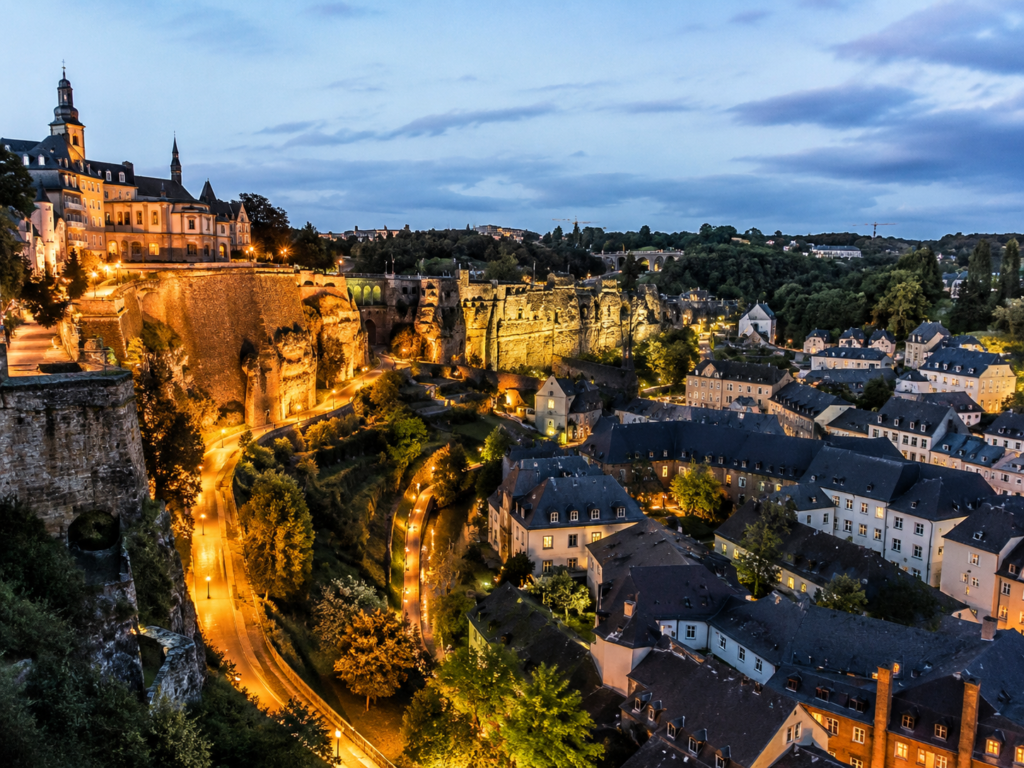
Luxembourg City is a UNESCO World Heritage Site. Its old town and fortress have been described by Victor Hugo – who knew his European scenery – as more beautiful than any castle on the Rhine. The Bock promontory, a sandstone rock formation above the Alzette River valley, contains a network of underground casemates carved over seventeen centuries of military engineering that stretch for over twenty-three kilometres. Medieval towers rise above a gorge that drops sixty metres below the upper city. The effect is of a European capital that decided at some point to be placed inside a dramatic painting and then never corrected the decision.
The thing about Luxembourg is this: the smaller the country, the more it has had to be certain about what it is. And Luxembourg is very certain. It speaks three official languages. It operates some of the most significant European institutions on the continent. It produces Moselle wine from vineyards along a river valley that has been in continuous cultivation since Roman times. And it has been, for reasons that almost nobody outside of financial and diplomatic circles fully understands, the quietly indispensable country at the centre of European governance for decades.
Nigerian travellers who discover Luxembourg rather than passing over it tend to become evangelists for it.
For Nigerian passport holders seeking access to this extraordinary Grand Duchy, a Luxembourg Schengen visa is required. Luxembourg is a founding member of the Schengen Area and the European Union and your approved visa unlocks travel across all 27 Schengen countries. Whether you’re travelling for tourism, visiting family, or attending a business event in one of Europe’s most international cities, this guide gives you everything you need to apply successfully.
Luxembourg is arguably Europe’s most underrated country. At roughly the size of Lagos State, it packs in medieval castles, lush Ardennes forests, and one of the world’s highest GDPs per capita. Kelechi, an Abuja-based financial analyst, visited Luxembourg for a banking conference and came back describing it as ‘like stepping into a fairytale with a Bloomberg terminal.’ The visa process, he said, was ‘nothing to be afraid of, if you follow the steps.’ Here are those steps.
Why Luxembourg?
Luxembourg might be small, but it punches well above its weight. It is one of Europe’s most prosperous nations, a global hub for banking and investment funds, and a trilingual country where French, German, and Luxembourgish coexist. Its fairy-tale castles and scenic river valleys make it a wonderful tourist destination too. As a Schengen member, a Luxembourg visa grants access to all 29 Schengen countries.
The Grand Duchy of Luxembourg is the world’s only remaining sovereign Grand Duchy. That title is not ceremonial – it is the formal constitutional designation of the state, meaning it is ruled by a Grand Duke rather than a king, president, or prime minister in the traditional sense. Grand Duke Henri has held the position since 2000. The title predates most of Europe’s current political arrangements by several centuries.
Luxembourg borders Belgium to the west and north, Germany to the east, and France to the south. This geographic position – at the exact intersection of three major European cultures is directly responsible for the three official languages, the culinary diversity, and the particular cosmopolitan quality of the capital city.
Luxembourg City sits on a plateau above two converging river valleys, the Alzette and the Pétrusse. The city is built on multiple levels connected by lifts, staircases, and bridges, and the visual effect of the old upper city rising above the lower Grund district is unlike anything in any other European capital of comparable size.
Outside the city: the Ardennes forest in the north, which becomes Luxembourgish in character as it crosses from Belgium — quieter, less visited, and genuinely beautiful in autumn. The Moselle valley wine region in the east, where villages like Remich and Grevenmacher sit on the German border producing white wines that never quite made it onto international restaurant lists, mostly because Luxembourg keeps drinking them. Vianden in the north — a medieval castle town of a scale and perfection that makes it seem implausible for a country this size, a fully intact Gothic castle rising above a river and a village of cobbled streets that exists in a way that does not feel theatrical.
Luxembourg also has one of the highest minimum wages in the European Union, a public transport system that became entirely free for all passengers in 2020 (the first country in the world to do this), and a financial sector that manages assets equivalent to roughly 250 times its annual GDP.
Small country. Large footprint. Worth a closer look.
What Is the Luxembourg Schengen Visa?
A Luxembourg Schengen visa is a short-stay authorisation allowing Nigerian passport holders to enter Luxembourg and all 27 Schengen Area countries for up to 90 days within any 180-day period. It covers tourism, family visits, and business travel. The standard adult fee is €80. As Luxembourg has no resident embassy in Nigeria, applications are processed through the Belgian Embassy or designated visa centre, as Belgium typically represents Luxembourg for consular purposes in countries where Luxembourg has no presence.
Luxembourg’s position at the heart of Europe bordering France, Belgium, and Germany makes it one of the most strategically located Schengen entry points for travellers who plan to explore multiple European countries.
Types of Luxembourg Visa Available for Nigerian Applicants
Luxembourg is a founding member of the Schengen Area and a core EU member state. Your entry document for Luxembourg is a Schengen visa — and like every Schengen visa, approval grants access to all 27 member states for the duration of its validity.
Schengen Type C — Short Stay
For stays up to 90 days within any 180-day window. This covers tourism, family and friend visits, business travel, conference attendance, medical appointments, and short academic programmes. Issued as single, double, or multiple-entry depending on your travel profile. This is the visa category that applies to the majority of Nigerian applicants.
National Long-Stay Visa (Type D)
For stays exceeding 90 days — enrolled students, workers on formal assignment, those beginning a residency process. Significantly more documentation required. This guide addresses Type C.
Where to Apply for a Luxembourg Schengen Visa in Nigeria
This is the single most important practical point for Nigerian applicants: Luxembourg does not maintain a resident embassy in Nigeria.
Luxembourg is represented for consular purposes in many countries by the Embassy of Belgium. This means Nigerian applicants are typically directed to submit their Luxembourg visa applications at the Belgian Embassy in Abuja or through a Belgian visa application centre operating in Nigeria.
Critically — this arrangement must be verified before you begin.
The designated representative for Luxembourg can change, and submitting to an incorrect embassy wastes your time and documents. Before preparing anything, visit the official Luxembourg Ministry of Foreign Affairs website (mae.lu) to confirm:
- Which embassy or visa centre currently processes Nigerian applications for Luxembourg
- Whether any change in the designated representative has occurred recently
Mr Schengen Visa can confirm this for you and manage the full logistics of your submission.
Luxembourg Schengen Visa Requirements for Nigerian Applicants
Most guides give you the list. This one gives you the list and the logic behind it, because understanding why each document exists changes how you prepare it.
Passport
Valid for at least three months after your last day in Luxembourg. Minimum two blank pages for stamps. If either condition is not met, renew before starting your application. This requirement admits no exceptions.
Schengen visa application form
Downloaded from the VFS Global Luxembourg portal or the official Embassy website. Completed in full — every field answered, signed personally, dated accurately. Third-party forms circulating online are frequently outdated versions that cause submission complications. Use the current official version only.
Biometric photographs
Two recent photographs, 35mm by 45mm, plain white background, taken within the past six months. Get these done professionally. A technically rejected photograph at submission costs you your appointment slot and produces nothing except frustration.
Schengen-compliant travel insurance
Minimum €30,000 in medical expense and emergency repatriation coverage, valid across all Schengen member states for every day of your stay. Read the policy document before purchasing. Some lower-cost products contain geographic exclusions or medical condition limitations that render them non-compliant with Schengen entry requirements. A non-compliant certificate is functionally the same as no insurance for the purposes of this application.
Flight itinerary
Round-trip travel dates showing your proposed arrival into Luxembourg and your return to Nigeria. A provisional booking from your travel agent — not a paid, non-refundable ticket — is the appropriate approach at this stage. Committing to non-refundable flights before a visa decision is received is financial exposure with no corresponding benefit.
Accommodation evidence
Confirmation of where you will stay for every night of your trip. Hotel reservations, certified apartment bookings, or a formal invitation letter from your contact in Luxembourg supported by their proof of residency and identification. Every night of the planned stay documented.
Bank statements
Three to six months from your primary account. Luxembourg is one of the wealthiest countries in Europe, and the financial benchmark applied in reviewing applications reflects that — approximately €100 per day of your planned stay is a sensible working figure.
What your statements are communicating to the reviewing officer is not a single balance figure. It is a credible financial narrative over time: consistent income, proportionate spending, and a position that makes the cost of this trip look sustainable rather than strained.
When that narrative is interrupted by unusual activity — a large transfer appearing without explanation two weeks before submission, a sudden balance increase that doesn’t correspond to documented income — it generates a question. Answering that question before it becomes a problem is straightforward: attach the supporting documentation. The invoice, the payment confirmation, the dividend record, the property transaction document. Evidence transforms ambiguity into verifiable fact. Without it, the officer fills the gap with their own interpretation.
Employment and income documentation
Employees: employer letter on official company letterhead confirming your job title, monthly salary, and approved leave dates. Three to six months of payslips alongside it.
Business owners: CAC registration certificate, business bank statements covering three to six months, and a letter on your business letterhead describing the purpose of your trip and explicitly confirming your intention to return to manage your operations in Nigeria.
Students: current enrolment letter and documentation of how the trip is funded — personal savings, family sponsorship, or institutional support.
Cover letter
The document that gives your application a voice.
Without a cover letter, the reviewing officer builds the narrative of your application themselves from whatever they can extract across multiple documents. With a specific, well-written one, you hand them the narrative directly — who you are, why Luxembourg specifically, what you plan to do and see, how accommodation and finances are arranged, and what is waiting for you in Nigeria when the visa expires.
Write it as yourself. Not from a template — officers who review applications professionally identify template language on first reading, and it contributes nothing to your file. Write specifically about why you chose Luxembourg. If it’s the UNESCO old town, say so and name what you plan to see. If it’s a business meeting at the European Investment Bank, describe it. If it’s visiting family, explain the relationship. Specificity is the only reliable signal of authenticity in a paper submission.
Additional Documents by Purpose of Travel
Tourism: A specific, day-by-day itinerary. “Luxembourg City old town and Bock casemates on day one, Vianden Castle on day two, Moselle valley wine region on day three, Grund district and EU institutions quarter on day four before departure.” That is a plan that demonstrates research and genuine intent. It is also, if you have never looked at a Luxembourg map, a credible summary of what a well-planned four-day visit there actually includes.
Business: Formal invitation letter from your Luxembourg host organisation, on company letterhead, naming you specifically, describing the nature and duration of the engagement, and confirming who covers your expenses.
Conference or academic event: Official registration confirmation or acceptance letter from the hosting institution.
Visiting family or friends: Signed invitation letter from your contact in Luxembourg, copies of their Luxembourg residency documentation, and evidence of their current address.
How to Apply for a Luxembourg Schengen Visa: Step by Step
Step 1 — Confirm your submission point
Visit mae.lu or contact Mr Schengen Visa to confirm which embassy currently processes Nigerian applications for Luxembourg. Typically this is the Belgian Embassy in Abuja.
Step 2 — Gather all required documents
Collect originals and one photocopy of each document. Arrange them clearly and logically — a well-organised file creates a professional first impression.
Step 3 — Complete the application form
Fill out every field accurately. Inconsistencies between your form and supporting documents are a common reason for delays and refusals.
Step 4 — Book your appointment
Contact the designated embassy and schedule your biometric appointment. Build in at least 8–10 weeks before your travel date given the indirect application process.
Step 5 — Attend, submit, and pay
Bring all documents to your appointment. Provide biometric data if required. Pay the visa fee:
- Adults: €80
- Children 6–12: €40
- Children under 6: Free
- Service charges from the application centre may apply additionally
Step 6 — Track and collect
Processing takes 10–15 working days from submission. Collect your passport from the embassy or arrange secure courier return if available.
Financial Requirements for a Luxembourg Schengen Visa
Luxembourg is one of the wealthiest countries in the world and one of the most expensive to visit. Its cost of living is comparable to Switzerland, with accommodation, dining, and transport all at a premium.
What your bank statements should demonstrate:
- An accessible balance of €100–€150+ per day of your stay
- Consistent monthly income, not a sudden pre-application deposit
- Clean transaction history with no irregular large cash movements
- Account maintained actively for at least 3–6 months
For a 5-day trip to Luxembourg City, you should be able to show at least €500–€750+ in accessible funds. Given the country’s wealth and living costs, consular officers expect financial documentation that reflects a comfortable, credible budget.
Why Applications Are Refused - The Consistent Patterns
Incomplete documentation Every item on the official checklist exists because the reviewing officer expects to see it. One missing document can cause an entire application package to be returned without a decision. Audit your submission physically against the checklist before attending your appointment.
Financial records that generate questions A credible six-month financial history is more valuable than a high closing balance without context. Unusual activity — large unexplained inflows immediately before submission — creates scrutiny. The supporting documentation that explains that activity is what protects you.
No demonstrated reason to return to Nigeria The reviewing officer is assessing whether you intend to leave Luxembourg when your visa expires. If your file contains nothing that functions as a compelling practical reason to return — no formal employment, no active business, no dependants, no significant assets — your application carries elevated perceived risk. Name your obligations explicitly in your cover letter.
Inconsistency across documents Every document referencing the same fact — employer name, home address, salary figure, travel dates — must state it identically. Discrepancies between documents create doubt that is difficult to correct after submission.
What Makes Luxembourg Worth Visiting?
A great itinerary does more than organise your trip, it signals to the consular officer that your visit is genuine, well-researched, and purposeful. Here’s what a strong Luxembourg travel plan might include:
- Luxembourg City Old Town and Casemates — A UNESCO World Heritage Site of remarkable fortifications carved into cliff faces; extraordinary and walkable in a day
- Grand Ducal Palace — The official residence of the Grand Duke; open for summer public tours
- Vianden Castle — One of the finest medieval castles in Western Europe, dramatically perched above the Our River Valley in the north
- Mullerthal Trail — Luxembourg’s “Little Switzerland”; sandstone rock formations and forest hiking trails
- Moselle Valley — Luxembourg’s wine-producing region along the river border with Germany; beautiful vineyard scenery and excellent Rieslings
- European Quarter — Home to the European Court of Justice, the European Parliament annexe, and other major EU institutions — fascinating for business and policy travellers
- MUDAM Contemporary Art Museum — World-class contemporary art in a stunning I.M. Pei-designed building
Even a 4–5 day itinerary covering Luxembourg City, a day trip to Vianden, and an afternoon in the Moselle Valley gives you a specific, credible plan to include in your cover letter.
The Correct Order of Preparation
- Confirm passport validity and available blank pages. Renew before anything else if needed.
- Verify the correct submission route — VFS directly or through Belgian consular representation.
- Book your appointment to establish a concrete working deadline.
- Gather financial documentation first — bank statements and employer records require the most lead time.
- Purchase Schengen-compliant travel insurance.
- Request a provisional flight itinerary from your travel agent. Do not pay for non-refundable tickets yet.
- Arrange refundable accommodation or obtain a formal invitation letter from your Luxembourg contact.
- Write your cover letter last, once all other documents are assembled.
- Submit your complete, organised package. Track it. Wait for a decision before committing to non-refundable travel expenses.
Luxembourg Is Small in Size, Limitless in Experience
Luxembourg rewards curious travellers who look beyond the obvious. Its medieval grandeur, its European institutional significance, its stunning natural landscapes, and its extraordinary wealth of history packed into a compact geography make it genuinely unique.
Your Luxembourg Schengen visa isn’t just an entry stamp into one small country – it’s a key to the entire Schengen zone, valid from Lisbon to Reykjavik. And getting it right requires understanding the indirect application process that countries like Luxembourg require.
At Mr Schengen Visa, we’ve helped Nigerian applicants navigate exactly these kinds of indirect application routes confirming submission points, reviewing documents, and building files that give consular officers every reason to say yes.
Frequently Asked Questions: Luxembourg Schengen Visa from Nigeria
Does Luxembourg have an embassy in Nigeria?
How long does Luxembourg visa processing take for Nigerians?
Can I visit France, Belgium, and Germany on a Luxembourg Schengen visa?
Why would a Nigerian traveller choose Luxembourg as their Schengen country?
Is Luxembourg more expensive than other Schengen destinations?
What is the Luxembourg Schengen visa fee?
Ready to Apply for Your Luxembourg Schengen Visa?
The Grand Duchy is waiting. Let’s get your visa sorted.
Don’t get caught out by an incorrect submission point or a missing document. Our team at Mr Schengen Visa will handle the complexity so you can focus on planning the trip.
Expert guidance. Stronger applications. Better outcomes. Book today.
Let us take the stress out of your visa application. Book a Free Consultation |
  Download Your Switzerland Visa Checklist
Address: KM 4 Gbongan – Ibadan Rd, opposite Sterling Bank, Osogbo 230284, Osun, Nigeria.
Phone: +234 816 237 7613 | Email: mrschengenvisa@gmail.com