Slovenia Visa Applications from Nigeria are Simpler than Most People Expect in 2026
How to Apply for a Slovenia Visa in Nigeria (Tourist, Visit & Business)
Here is something that happens more than you’d think.
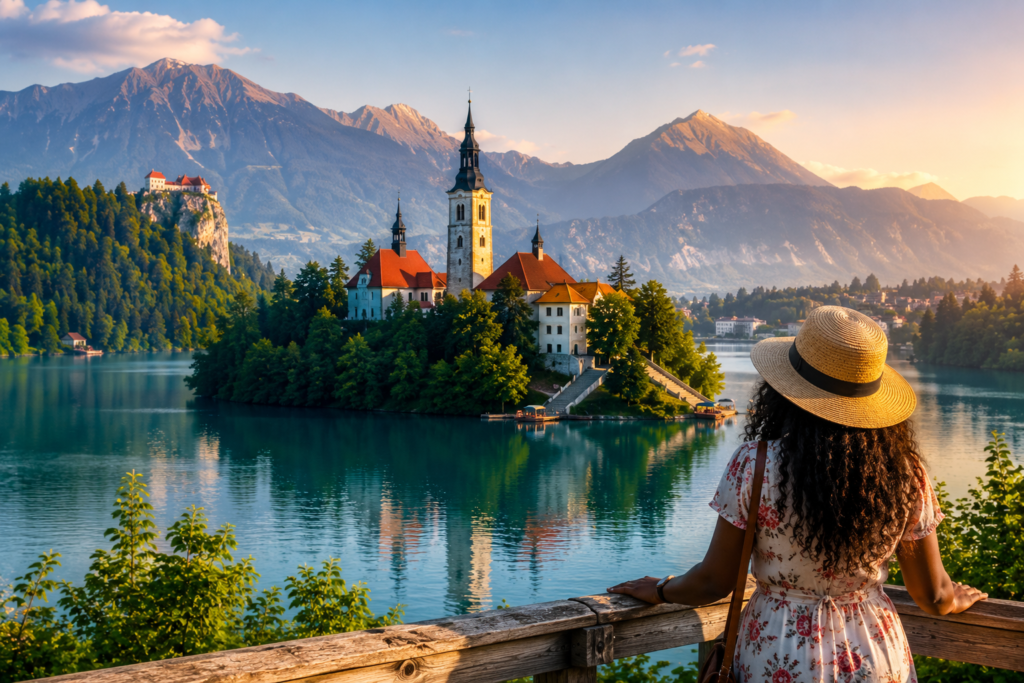
Someone sees a photograph of Lake Bled – that famous image of a lone church sitting on a tiny island in the middle of an emerald Alpine lake, mountains rising behind it like something assembled specifically to humble you and they think it’s Switzerland, Or Austria, Or somewhere impossibly expensive and far from anything they might realistically visit.
Then they find out it’s Slovenia, and they think: “Where is that, exactly?”
Then they confuse it with Slovakia.
This is the journey almost every Nigerian traveller takes before they actually go to Slovenia and discover that the photograph, somehow, doesn’t do the place justice. The country is smaller than Edo State. It shares borders with Italy, Austria, Hungary and Croatia. It joined the Schengen Area in 2007, adopted the euro in 2008, and has been quietly producing some of the most dramatic landscapes, cleanest air, and most charming medieval towns in the whole of Europe ever since — largely without the world noticing.
Those who notice, though, tend to return.
If you’re reading this, you’ve noticed. Here’s everything you need to know about getting there from Nigeria.
When Funke first mentioned she was going to Slovenia, most of her friends in Port Harcourt asked, ‘Is that even a country?’ It absolutely is and one of Europe’s most beautiful ones at that. Lake Bled, with its island church and mountain backdrop, looks like something out of a fantasy novel. Funke returned with hundreds of photos and one piece of advice for anyone wanting to follow her: ‘Start your visa application early, get your documents right, and don’t stress. It is very doable.’ This guide is everything she wished she had known before she started.
Why Visit Slovenia? A Quick Case for Going
Slovenia joined the Schengen Area in 2007, meaning one visa unlocks 29 European countries. Beyond the Schengen benefit, Slovenia itself offers:
- Lake Bled consistently ranked among Europe’s most photographed destinations
- Ljubljana – a UNESCO-celebrated capital city that is entirely walkable and virtually car-free in its historic centre
- Triglav National Park – Slovenia’s only national park, with alpine terrain, glacial lakes, and the iconic Soča River
- Postojna Cave – one of Europe’s largest cave systems, drawing over 800,000 visitors annually
- A stable, growing economy with opportunities in logistics, IT, and European trade
According to the Slovenian Tourist Board, the country welcomed over 6.7 million tourist arrivals in its peak year before the pandemic, a remarkable figure for a country of just 2 million people. The international footprint is real.
Slovenia is a tiny Central European country nestled between Italy, Austria, Croatia, and Hungary and it packs an extraordinary amount of beauty into its compact size. Think emerald rivers, alpine villages, limestone caves, and a charming capital city in Ljubljana. For business travellers, Slovenia is a stable economy with growing opportunities in technology, manufacturing, and logistics.
As a Schengen member, your Slovenia visa allows free travel across all 29 Schengen countries.
Let's Talk About the Visa Itself
Slovenia is a full Schengen member, so what you’re applying for is technically a Schengen visa. The same document that gets you into Paris gets you into Ljubljana. The same stamp that opens Amsterdam opens Piran — Slovenia’s Venetian-influenced coastal town on the Adriatic, which looks like it was borrowed from Italy and never given back.
For Nigerian applicants, two visa types are relevant.
Type C — Short Stay
This is the one most people need. It covers trips of up to 90 days within any 180-day period, and applies to tourism, family visits, business travel, medical appointments, conference attendance, and short courses. A single-entry Type C visa is what a first-time Slovenian visitor from Nigeria should expect. Multiple-entry visas are possible, but they come with a travel history.
Type D — Long Stay National Visa
If your reason for going requires more than 90 days — a degree programme, extended work assignment, or the beginning of a residency process — you’ll need a Type D. The documentation is more involved, and the processing works differently. This guide is built around Type C, which covers the overwhelming majority of Nigerian applications.
Slovenia doesn’t maintain a standalone embassy in Nigeria. Schengen visa applications destined for Slovenia are processed through VFS Global, which acts on behalf of the Slovenian consular authorities. There are two VFS application centres in Nigeria:
Lagos: Sanusi Fafunwa Street, Victoria Island Abuja: Joseph Gomwalk Street, Asokoro
Appointments are non-negotiable. The centres do not accept walk-ins, and slots are limited. During peak travel seasons — particularly the months leading up to European summer — availability tightens considerably. Book your appointment before you’ve finished gathering your documents, not after. Having a concrete date creates a deadline that sharpens the whole preparation process.
Required Documents
This is where most guides fall short. They list requirements without explaining what those requirements are actually trying to demonstrate to a consular officer sitting on the other side of the process.
Here’s the thing about visa reviewing: officers are not looking for reasons to approve you. They’re looking for reasons to trust that you are who you say you are, will do what you say you’ll do, and will leave when your visa expires. Every document you submit is either building or undermining that trust.
With that in mind, here is what you’ll need — and why each piece matters.
Passport
Valid for at least three months after your planned return to Nigeria, with a minimum of two blank pages remaining. There is no discretion on this. If your passport is close to expiry or almost full with stamps, renew it first. The renewal is straightforward. The alternative — a rejected application — costs you money and time.
Completed application form
The standard Schengen visa application form, fully completed, with no blank fields left unanswered. Where a question genuinely doesn’t apply to you, write “N/A” rather than leaving it empty. Empty fields read as carelessness to a reviewing officer. Download the form directly from the VFS portal — forms from third-party websites may be outdated versions that cause problems at submission.
Biometric photographs
Two recent photos, 35mm by 45mm, plain white background, neutral facial expression, face clearly visible. Get these done at a professional photography studio. Rejected photographs for technical non-compliance are a frustration that is entirely within your control to avoid.
Travel insurance
A valid policy covering all Schengen member states for the full duration of your trip, with a minimum coverage amount of €30,000 for medical and emergency repatriation. This is mandatory, not advisory. Read the terms before purchasing — cheaper policies sometimes have geographic exclusions or medical condition limitations that render them technically non-compliant. The cost of a rejected visa outweighs the marginal saving on a cheaper insurance policy by a considerable margin.
Flight itinerary
Round-trip travel dates showing when you intend to enter and exit the Schengen zone. A provisional booking from a travel agent — not a fully paid non-refundable ticket — is acceptable and recommended. You have no business paying for flights before you have a visa stamp in your passport.
Accommodation evidence
Hotel reservations, Airbnb bookings, or a formal letter of invitation from your host in Slovenia for every night of your stay. If you’re staying with someone, they’ll need to provide a copy of their residence permit or identification alongside the invitation letter and their proof of current address.
Bank statements
Three to six months of statements from your primary account. What the embassy is assessing here is not a single number — it’s a pattern. Is there consistent income? Are there regular outflows that suggest an active, functioning financial life? Is the balance appropriate for the cost of the trip?
The approximate benchmark is €50 to €100 per day of travel. But be aware: a bank account that shows a suspiciously large deposit in the two weeks before submission triggers questions, not confidence. If your account received a significant transfer recently for legitimate reasons — a client payment, a dividend, a property sale — include documentary evidence to explain it. A Nigerian business owner who can attach the relevant invoice and transfer confirmation has no problem here. One who doesn’t, might.
Proof of employment or business activity
If you’re in formal employment: an employer’s letter on official letterhead confirming your job title, salary, and approved leave period. Payslips for the corresponding months.
If you’re self-employed or running a business: your CAC certificate, business account statements, and a letter on business letterhead explaining the purpose of your trip and confirming your intention to return to manage your operations.
If you’re a student: an enrollment letter and evidence of how your trip is being funded.
Documents Specific to Your Purpose of Travel
Tourism: A believable, specific itinerary showing where you’ll be on each day of your trip. Not a generic statement about wanting to “explore Europe,” but a named sequence: Bled on days one and two, Ljubljana on days three and four, Piran on days five and six, Triglav National Park on day seven. The level of specificity signals genuine research and genuine intent.
Business: A formal invitation letter from your Slovenian host organisation on company letterhead, naming you specifically, describing the nature of the meeting or engagement, and confirming who is covering your travel costs and expenses.
Conferences or academic events: A registration confirmation or acceptance letter from the event or institution.
Family and friend visits: A signed, dated invitation letter from your host, alongside copies of their proof of residence and residency status in Slovenia.
Application Process
Step 1 — Use VFS Global
Slovenia visa applications in Nigeria are processed through VFS Global. Visit the VFS Global website to access the application form, document checklist, and appointment booking portal.
Step 2 — Prepare Your Documents
All forms must be filled out completely in English and signed. VFS Global will not accept incomplete applications so double-check everything before your appointment.
Step 3 — Book and Attend Your Appointment
Book your appointment online and attend in person with both originals and photocopies of all documents. Biometric data will be collected at this stage.
Step 4 — Pay the Visa Fee
The standard Schengen visa fee is €90 for adults. Additional VFS service charges apply. All fees are non-refundable.
Step 5 — Wait for Your Decision
Standard processing is 15 calendar days from when your application is registered at the embassy (not from the VFS submission date). Apply well in advance of your travel.
A Slovenia Schengen visa typically takes 15 calendar days to process from the date the embassy registers your application. In complex cases, processing may extend to 30–45 days. Nigerian applicants should apply at least 6–8 weeks before their planned travel date.
Financial Requirements
Aim to show €60–€100 per day of your stay in accessible bank funds. Slovenia is affordable by Western European standards, but your statements need to reflect a realistic ability to cover your trip expenses.
Why Applications Get Declined and How Each Reason Is Avoidable
Staging your finances
A savings account that shows €400,000 naira equivalent for five months and then suddenly has €3,000,000 equivalent two weeks before your application date looks exactly as suspicious as it sounds. Consular officers see this pattern often enough that it has become a standard red flag. If you’re genuinely wealthy and your account genuinely received funds for a legitimate reason, your supporting documents should be able to demonstrate that clearly.
A cover letter that could belong to anyone
The cover letter is your voice in an otherwise silent paper submission. A cover letter that reads like it came from a template — and they often do, because people Google “Schengen visa cover letter sample” and copy the first result — adds nothing and signals a lack of authentic engagement with the process. Write yours specifically. Name the places you’re going. Explain why you chose Slovenia and not somewhere else. Describe what you’re going back to in Nigeria. Make it sound like a person wrote it, because a person should have.
Documents that contradict each other
Your application form says you’re an entrepreneur. Your only bank account is a personal savings account with a student-level balance. Your employer’s letter lists a company that doesn’t match the name on your CAC certificate. Each of these individually might be explainable. Together they suggest an applicant who isn’t being fully honest, even when the reality is simply poor document organisation.
Weak ties to Nigeria
This is the underlying anxiety behind almost every rejection. The embassy needs to believe you are going to Slovenia for the reason you’ve stated and returning to Nigeria when you said you would. If your file contains nothing that would make leaving Nigeria and coming back a natural, inevitable outcome — no dependants, no property, no business obligations, no formal employment — you need to address that directly. Your cover letter is where this argument is made.
Top Tips to Maximise Your Slovenia Visa Approval Rate
- Apply early; 6 to 8 weeks before departure is ideal. Rushed applications increase rejection risk.
- Keep bank balance stable for 3–6 months before applying. Sudden large deposits attract scrutiny.
- Your cover letter should name every city and attraction you plan to visit. Vague letters are a red flag.
- Prior Schengen travel history is a major positive signal. Include it prominently if you have one.
- Never book non-refundable flights until after your visa is approved.
- Ensure all details – name spelling, dates, address are identical across every document.
What Experienced Applicants Do Differently
They treat their cover letter as the most important document in the folder, not an afterthought.
They apply for exactly the duration their itinerary requires, not the maximum available.
They include their full international travel history — every prior visa, every stamp — because compliance is an asset and it should be visible.
They prepare their financial documents well in advance so that any large transactions have a month or two of account history behind them rather than sitting fresh at the top of the latest statement.
And they never book anything non-refundable until they’re holding the visa in their hand.
One Genuinely Useful Thing to Know About Slovenia Before You Go
Slovenia has the highest proportion of forested land of any country in Europe after Finland and Sweden. More than half the country is covered in trees. This is relevant not as a geography fact but as a way of understanding what the country actually is — deeply, structurally natural in a way that most of Europe has urbanised its way out of.
Lake Bled is the famous photograph. But Soča Valley is where travellers who’ve been to Bled go next — a river of impossible turquoise running through limestone gorges that feel genuinely prehistoric. Triglav National Park covers much of the northwest and contains terrain that serious hikers travel from across the continent to access. Ljubljana, the capital, is compact, walkable, and has a castle that doesn’t charge tourist-trap prices to visit.
The country is small enough to see properly in two weeks. It’s significant enough that two weeks won’t feel like enough.
Do the paperwork carefully. Then go and see what you’ve been confusing with Slovakia all this time. If you need help don’t hesitate to contact Mr. Schengen Visa.
Frequently Asked Questions - Slovenia Visa Nigeria
Do Nigerians need a visa to visit Slovenia?
Where do Nigerians apply for a Slovenia visa?
How long is a Slovenia Schengen visa valid?
Can I use a Slovenia visa to travel to other European countries?
What is the best time of year to visit Slovenia?
What happens if my Slovenia visa is refused?
Start Your Slovenia Journey Today
Slovenia is waiting and so are our visa experts. At Mr Schengen Visa, we’ve helped hundreds of Nigerians secure their Schengen visas with confidence.
Let us take the stress out of your visa application. Book a Free Consultation |
  Download Your Slovenia Visa Checklist
Address: KM 4 Gbongan – Ibadan Rd, opposite Sterling Bank, Osogbo 230284, Osun, Nigeria.
Phone: +234 816 237 7613 | Email: mrschengenvisa@gmail.com