
Applying for an Iceland visa from Nigeria is more straightforward than the destination suggests in 2026
How to Apply for an Iceland Visa in Nigeria (Tourist, Visit & Business)
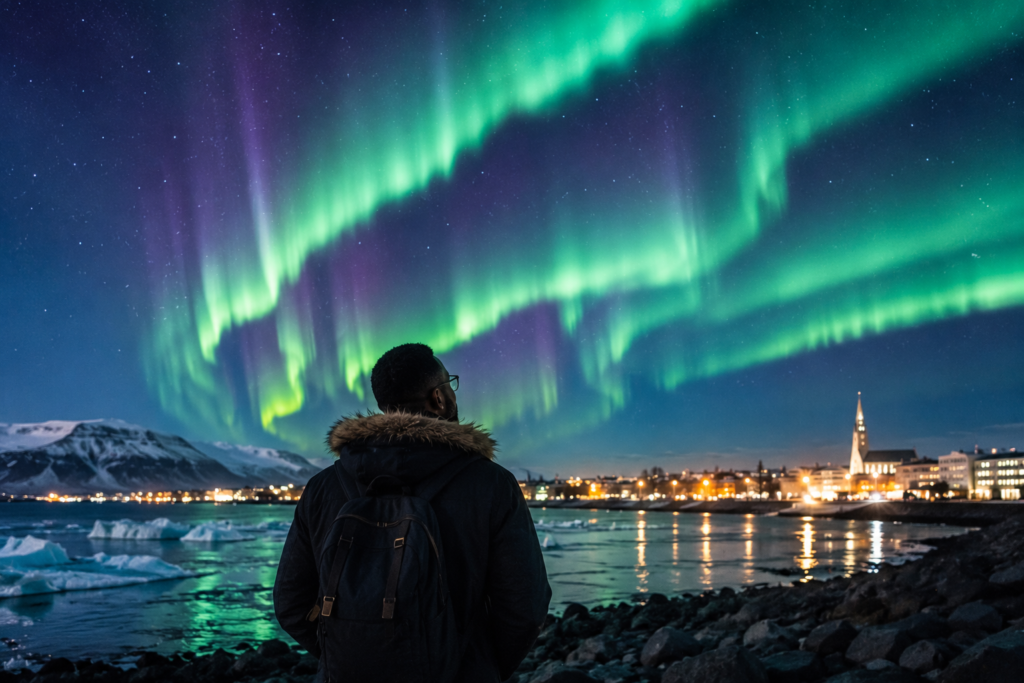
There’s a particular dishonesty in how Iceland is photographed. The Northern Lights look spectacular in a thirty-second exposure camera shot, and they are spectacular in real life but what the photographs don’t communicate is the cold, the silence, and the way the light actually moves. It pulses and ripples across the sky in a way that is genuinely disorienting the first time you watch it, as though the atmosphere itself is performing.
The midnight sun which operates from approximately late May through July produces the opposite effect. Daylight that refuses to end. A 2am sky that looks like 6pm in Lagos. The psychological strangeness of this is real and documented: visitors report altered sleep, strange energy levels, and a sense of time becoming irrelevant in a way that city life doesn’t permit.
Beyond these headline phenomena, Iceland offers:
The Geysir geothermal area in the Golden Circle, where Strokkur erupts approximately every five to ten minutes, shooting boiling water fifteen to twenty metres into the air with a reliability that feels almost mechanical. The original geyser — from which the English word derives — still sits dormant nearby, a geological reminder that Iceland’s surface is not finished yet.
The Jökulsárlón glacier lagoon, where icebergs calved from the Vatnajökull glacier float slowly toward the Atlantic in shades of blue that have no commercial equivalent. Photographers come from across the world specifically for this location. No filter reproduces it accurately.
Þingvellir National Park, where you can stand in the rift valley between the North American and Eurasian tectonic plates simultaneously. This is not a metaphor or a tourist board exaggeration. You can physically stand on both continental plates at once, in a national park that is also the site of the world’s oldest functioning parliament, established in 930 AD.
The Blue Lagoon — which the internet has made famous and which almost nobody correctly describes — is geothermal water created as a byproduct of the nearby Svartsengi power plant. It is simultaneously industrial in its origins and genuinely extraordinary as an experience. It requires advance booking, is worth the cost, and is nothing like the photographs suggest in ways that are difficult to communicate until you’re actually in it.
Iceland is also, for the record, one of the safest countries on earth. It has no standing army, one of the world’s lowest crime rates, and a culture of collective trust that produces functional, unhurried social interactions. For Nigerian visitors considering travelling alone, including solo women travellers, Iceland is consistently recommended by international safety indices as a benchmark destination.
There are some places on Earth so extraordinary that travellers return from them fundamentally different. Iceland is one of those places. Geysers erupting from ancient volcanic fields. Waterfalls tumbling off sheer cliffs into glacial river valleys. The Northern Lights – the aurora borealis painting the night sky in waves of green, violet, and white.
As a Nigerian passport holder, you need an Iceland Schengen visa to experience any of it. Iceland is not an EU member, but it is a founding Schengen member – so your Iceland visa opens all 29 Schengen countries. Applications in Nigeria go through VFS Global. This guide tells you exactly how to succeed.
Biodun had seen a photo of the Northern Lights dancing over an Icelandic glacier and immediately added it to his bucket list. He assumed Iceland would be nearly impossible to visit as a Nigerian. Then he discovered that Iceland, though not an EU member, is a Schengen country and the visa process follows the same well-established framework as any other Schengen state. With the right documents and enough lead time, Biodun watched the aurora borealis paint the night sky above Reykjavik within a year of first seeing that photo.
A Critical Fact: Iceland Is in Schengen, Not the EU
This confuses people, so it’s worth stating clearly.
Iceland is not a member of the European Union. It held a referendum in 2012 and voted against accession. It is, however, a full member of the Schengen Area — the passport-free travel zone – which means its visa framework runs through the Schengen system.
The practical consequence for Nigerian applicants: your entry permit for Iceland is a Schengen visa, processed through the same framework as France, Germany, or Spain, but handled by Icelandic consular authorities independently. A valid Icelandic Schengen visa also grants you access to all 27 other Schengen member states for the duration of its validity.
Applications from Nigeria are submitted through VFS Global, which processes Icelandic Schengen applications on behalf of the Icelandic Embassy. VFS centres are located in Lagos and Abuja. Appointments are mandatory — no walk-in submissions are accepted.
Iceland is unlike any other destination on Earth. Consider:
- Iceland welcomes over 2 million international tourists annually – remarkable for a country of just 370,000 people
- The country runs on nearly 100% renewable energy – geothermal and hydropower making it one of the world’s greenest destinations
- It consistently ranks in the world’s top 3 most peaceful countries (Global Peace Index)
- Iceland has no standing army and one of the world’s highest literacy rates
- Reykjavik is the world’s most northerly capital city and one of its most vibrant
- The Northern Lights are visible from September to March, with peak visibility in December and January
Iceland is one of only four non-EU Schengen members (alongside Norway, Switzerland, and Liechtenstein). As a member of the Schengen Area, an Iceland visa allows you to travel freely across all 29 Schengen countries during the validity of your visa. Iceland itself is famous for geysers, waterfalls, volcanic landscapes, the midnight sun, and the northern lights – truly one of the world’s most unique destinations.
Iceland Visa Types for Nigerian Applicants
Schengen Type C — Short Stay
For visits of up to 90 days within any 180-day period. Covers tourism, family visits, business travel, conference attendance, medical appointments, and short academic programmes. Available as single, double, or multiple-entry depending on your travel profile and history. This is the relevant category for the vast majority of Nigerian applicants.
National Long-Stay Visa
For stays exceeding 90 days — enrolled students, long-term workers, or those beginning a residency process. Documentation requirements differ substantially. This guide covers the Type C short-stay application.
Every Document You Need And What Each One Is Actually Doing
Passport
Valid for at least three months after your final day in Iceland, with a minimum of two blank pages remaining. Renew before applying if either condition is not met. Iceland’s entry requirements on this point are non-negotiable.
Completed Schengen visa application form
The current version, downloaded directly from the VFS Global Iceland portal or the official Icelandic Embassy website. Older forms from third-party sources cause submission complications. Complete every field — blank spaces signal an incomplete or inattentive application to the reviewing officer. Sign and date the form personally.
Biometric photographs
Two recent photographs, 35mm by 45mm, taken against a plain white background within the past six months. Have these produced professionally. The specifications are precise and a technically rejected photograph costs you your appointment slot without gaining you anything.
Schengen-compliant travel insurance
Minimum €30,000 in medical coverage and emergency repatriation, valid across all Schengen member states for every day of your visit. Iceland is geographically remote and medically expensive — this requirement is not bureaucratic padding. Read the policy document before purchasing. Budget travel insurance products sometimes contain geographic exclusions or activity limitations — glacier hiking, snowmobiling, and off-road activities are examples of things that lower-cost policies occasionally exclude. Verify your coverage extends to what you actually plan to do.
Flight itinerary
Round-trip travel dates showing your proposed entry into Iceland and your departure back to Nigeria. A provisional booking issued by your travel agent — not a paid, non-refundable ticket — is the accepted approach. Paying for flights before receiving a visa decision is a risk with no corresponding upside.
Accommodation confirmation
Documentary evidence of where you will stay for every night of your trip. Hotel reservations, certified Airbnb bookings, or if you’re staying with a contact in Iceland, a formal invitation letter supported by their identification and proof of their Icelandic address. Every single night must be accounted for.
Bank statements
Three to six months from your primary account. Iceland is consistently ranked among the ten most expensive countries on earth for travellers — the financial benchmark applied to applications reflects this reality. A working figure of approximately €100 per day of your stay is commonly applied, though individual officers assess the complete picture of your financial circumstances rather than a single number.
What your bank statements need to demonstrate is credibility, not perfection. Consistent income, proportionate expenditure, and a balance that can plausibly support this trip without apparent financial stress. The months of history matter as much as the current figure.
Large, unexplained deposits appearing in the two to four weeks immediately before your submission are among the most consistent triggers for additional scrutiny during review. If your account received significant funds for a legitimate reason — a business payment, a property transaction, a dividend — include documentation that explains the inflow clearly. An invoice, a transfer confirmation, a contract. Evidence transforms an ambiguity into a verifiable fact. Without it, the reviewer must draw their own conclusion, and that conclusion may not favour your application.
Employment and income documentation
For employees: a letter from your employer on official company letterhead confirming your position, your monthly salary, and your approved leave dates. Three to six months of payslips alongside it.
For business owners: your CAC registration certificate, business bank statements covering three to six months, and a letter on your business letterhead explaining your reason for travel and explicitly stating your intention to return to Nigeria.
For students: a current enrolment letter and evidence of how your trip is financed, whether through personal savings, family sponsorship, or a scholarship.
Cover letter
Not always listed as mandatory. Always present in strong applications.
Your cover letter is the only place where you speak directly in an otherwise impersonal paper submission. It should explain who you are, why Iceland specifically, what you plan to do during your stay, how every night of accommodation is covered, how the trip is funded, and what is waiting for you in Nigeria when your visit ends.
Write it as yourself. Not from a template — the reviewing officer has read thousands of applications and recognises borrowed language immediately. A personal, specific, honest letter that tells a coherent story about this trip and this applicant outperforms a polished template every time. Two to three focused paragraphs written with genuine attention are worth more than a full page of generic language that could describe any applicant travelling to any country.
Additional Documents by Travel Purpose
Tourism: A specific, named daily itinerary. “Golden Circle on day one: Þingvellir, Geysir, Gullfoss. South Coast on day two: Seljalandsfoss waterfall, black sand beaches of Vík. Blue Lagoon visit on day three before departure.” That is a plan. It demonstrates research, genuine intent, and a realistic understanding of how long things take in Iceland — including the fact that distances between attractions are significant and driving conditions change rapidly.
Business travel: A formal invitation letter from your Icelandic host organisation on company letterhead, naming you specifically, describing the nature and dates of the engagement, and confirming who covers your expenses.
Conference or academic events: Official registration confirmation or acceptance letter from the host institution.
Visiting family or friends: A signed, dated invitation letter from your contact in Iceland, alongside copies of their Icelandic residence permit or passport, and documentary evidence of their current residential address.
Best Time to Visit Iceland — Seasonal Guide for Nigerian Travellers
Iceland’s appeal changes dramatically by season. Plan your application timing around your travel goal:
| Season | Months | Main Appeal | Daylight |
|---|---|---|---|
Winter |
November – February |
Northern Lights, snow landscapes, Ice Hotel |
4–6 hours |
Spring |
March – May |
Northern Lights + first greenery, fewer crowds |
Up to 16 hours |
Summer |
June – August |
Midnight sun, puffins, hiking, festivals |
Up to 24 hours |
Autumn |
September – October |
Northern Lights return, fall foliage, whale watching |
Up to 14 hours |
Step-by-Step: How to Apply for an Iceland Visa from Nigeria
Step 1 — Access VFS Global for Iceland
Iceland visa applications from Nigeria are processed through VFS Global. Visit visa.vfsglobal.com/nga and select Iceland as your destination to access the current document checklist and appointment booking system. Confirm the application centre arrangement, Iceland may be represented through another Schengen country’s embassy in some configurations; verify on the VFS portal.
Step 2 — Prepare Your Full Document File
All documents must be in English. Non-English documents require official certified translation. Prepare both originals and one complete set of photocopies for every document on the checklist.
Step 3 — Attend Your VFS Appointment in Person
Book through VFS Global and attend in person on your scheduled date. Bring all originals and photocopies. Biometrics will be collected. If you’ve had biometrics collected within the last 59 months, you may not need to re-provide fingerprints.
Step 4 — Pay the Visa Fees
The standard Schengen visa fee is €90 for adults. VFS service charges apply additionally. All fees are payable in Naira and are non-refundable.
Step 5 — Wait for Your Decision
Standard processing takes 15 calendar days. In complex cases, it may extend to 30–45 days. Apply at least 6–8 weeks before your travel date especially for peak Northern Lights season (December–February) when demand is high.
Iceland Travel Budget Guide for Nigerian Applicants
Iceland is not a budget destination. Being realistic about costs strengthens your visa application and helps you plan a trip you will actually enjoy:
| Expense Category | Budget Range (per day) | Notes |
|---|---|---|
Accommodation |
€80–200 |
Budget hostels to mid-range hotels. Reykjavik is pricier. |
Food & Drink |
€40–80 |
Self-catering reduces costs significantly |
Car Rental (if applicable) |
€50–120 |
Essential for Golden Circle and South Coast |
Entrance Fees & Tours |
€20–80 |
Northern Lights tours, Golden Circle, whale watching |
Total Daily Estimate |
€150–250 per person |
Multiply by your trip duration for bank statement guidance |
Why Applications Get Rejected And What to Do Instead
Incomplete documentation at submission Every checklist item exists because the reviewing officer expects to see it. A single missing document can return an entire application package without a decision. Audit your submission against the checklist methodically before attending your appointment.
Financial history that creates unanswered questions Iceland is expensive. Your financial documentation needs to demonstrate that you can fund this trip without difficulty and without staging. Accounts that show sudden, unexplained increases immediately before submission, or that show inconsistent income relative to the cost of the planned trip, generate scrutiny. Provide context through supporting documentation wherever your account history might raise legitimate questions.
Insufficient proof of ties to Nigeria The consulate is assessing whether you intend to return when your visa expires. If your application file contains nothing that constitutes a compelling reason to leave Iceland and go home — no employment, no business, no dependants, no significant assets in Nigeria — your application carries higher perceived risk. Address this directly in your cover letter. Describe what you are going back to.
Documents that contradict each other Every document in your submission should tell an identical story at every point where the facts overlap. The same employer name. The same home address. The same salary figure. Inconsistencies between documents that reference the same fact create doubt that is difficult to dispel after submission.
The Correct Order of Preparation
- Confirm your passport validity and available blank pages. Renew before anything else if needed.
- Book your VFS appointment to establish a concrete deadline.
- Gather financial documentation first — bank statements and employer letters require the most lead time.
- Purchase Schengen-compliant travel insurance. For Iceland specifically, verify that adventure activities you plan to do are covered.
- Request a provisional flight itinerary from a travel agent. Do not pay for non-refundable flights yet.
- Arrange refundable accommodation or obtain a formal invitation letter from your Icelandic contact.
- Write your cover letter last, when all other documents are ready and you can describe the full package accurately.
- Submit everything. Track your application. Wait for a decision before committing to non-refundable travel costs.
Frequently Asked Questions — Iceland Visa Nigeria
Do Nigerians need a visa to visit Iceland?
When is the best time to see the Northern Lights in Iceland?
Is Iceland safe for Nigerian tourists?
How much money do I need for an Iceland trip?
Can I drive in Iceland with a Nigerian licence?
What is the Golden Circle in Iceland?
Final Thoughts; Iceland Will Change You
Few places in the world can rival Iceland for sheer natural wonder. Whether you are chasing the northern lights, soaking in a geothermal lagoon, or exploring a lava field, Iceland will leave you changed.
There is a reason travellers return from Iceland speaking about it differently from any other place they have visited. It is not just beautiful — it is transformative. The silence of a lava field at midnight under the Northern Lights is something photographs cannot capture and words cannot fully convey.
Your Iceland Schengen visa application, handled correctly, is absolutely achievable from Nigeria. Start early, build a detailed itinerary, prepare strong financial documentation, and submit through VFS Global with plenty of lead time.
And when you want expert support from people who have guided hundreds of Nigerian applicants to successful Schengen visa outcomes – Mr. Schengen Visa is ready to help.
At Mr. Schengen Visa, we help Nigerian applicants prepare applications that stand out. Contact us today and let’s start your Icelandic adventure.
Ready to Apply for Your Iceland Schengen Visa?
Navigating the Schengen visa process can feel overwhelming but it doesn’t have to be. At Mr Schengen Visa, our expert consultants help Nigerian applicants put together airtight visa files that maximize approval chances.
Let us take the stress out of your visa application. Book a Free Consultation |
  Download Your Slovenia Visa Checklist
Address: KM 4 Gbongan – Ibadan Rd, opposite Sterling Bank, Osogbo 230284, Osun, Nigeria.
Phone: +234 816 237 7613 | Email: mrschengenvisa@gmail.com