
Discover How to Successfully Apply for a Slovakia Visa From Nigeria in 2026
How to Apply for a Slovakia Visa in Nigeria (Tourist, Visit & Business)
Nobody talks about Slovakia.
Ask ten Nigerians planning a European trip where they want to go, and you’ll hear Paris, Amsterdam, London, maybe Rome or Barcelona if someone’s feeling adventurous. Slovakia? Almost never.
That’s partly because Slovakia has done an exceptionally poor job of marketing itself to the rest of the world. But here’s what the people who’ve actually been there know: it has the dramatic castle-topped landscapes of Austria without the crowds, the medieval architecture of Prague without the tourist premiums, and an outdoor culture — hiking, skiing, cycling through river valleys — that most Western European cities simply cannot offer.
Bratislava, its capital, sits on the Danube and shares a border with both Austria and Hungary. You can be in Vienna in under an hour. Budapest in two. The entire country is smaller than Ondo State, yet it contains Tatra Mountain peaks that rival the Alps, a UNESCO-listed cave system, and a thermal spa culture that Central Europeans have been quietly enjoying for centuries.
If you’ve been looking for a European destination that’s genuinely different from the standard itinerary, Slovakia is worth your attention.
And getting there from Nigeria, while it requires careful preparation, is entirely achievable. Here’s what you actually need to know.
What Is a Slovakia Schengen Visa?
Slovakia is a hidden gem in Central Europe – medieval castles, High Tatra mountains, and a thriving capital in Bratislava. Nigerian passport holders need a Slovakia Schengen visa to visit. As a Schengen member, this visa also covers travel across all 29 other Schengen countries.
Why Visit Slovakia?
Slovakia is a Schengen country, meaning your Slovakia visa grants you access to all 29 Schengen member states. The country is home to Bratislava – one of Europe’s most compact and charming capital cities – the High Tatras mountains, medieval towns, and over 180 castles. For business travellers, Slovakia is a rapidly growing economy and a gateway to Central European markets.
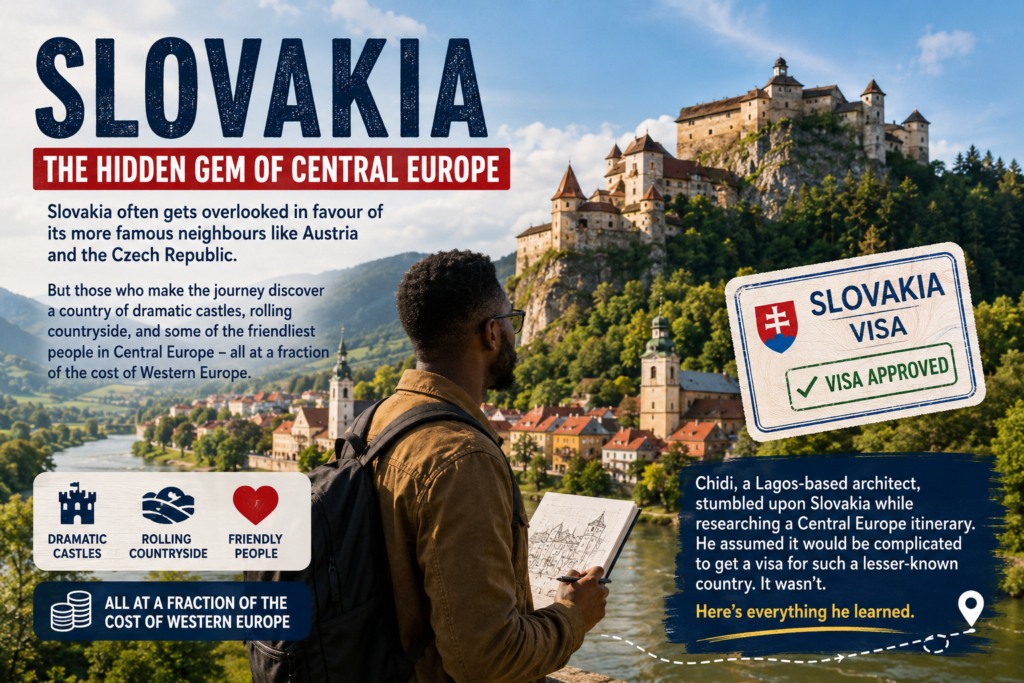
Slovakia often gets overlooked in favour of its more famous neighbours like Austria and the Czech Republic. But those who make the journey discover a country of dramatic castles, rolling countryside, and some of the friendliest people in Central Europe – all at a fraction of the cost of Western Europe. Chidi, a Lagos-based architect, stumbled upon Slovakia while researching a Central Europe itinerary. He assumed it would be complicated to get a visa for such a lesser-known country. It wasn’t. Here’s everything he learned.
Visa Types for Nigerians Visiting Slovakia
Slovakia joined the Schengen Area in 2007, which means a Slovak visa is a Schengen visa. Approval grants you access to 29 member states — you can enter through Bratislava and travel onward to Austria, Germany, the Czech Republic, Poland, or any other Schengen country without additional border formalities.
There are two categories relevant to Nigerian applicants.
Type C — Short Stay
This is the standard visa for tourism, family visits, business trips, conferences, and medical travel. It allows a maximum of 90 days within any 180-day window and is the right application for the vast majority of people reading this guide.
Type D — Long Stay National Visa
This is for those planning to remain in Slovakia beyond 90 days — students, long-term workers, or those beginning a relocation process. It requires significantly more documentation and leads, in most cases, toward a temporary residence permit rather than just a travel visa. This guide focuses on Type C.
Where Applications Are Submitted in Nigeria
Slovakia does not have a dedicated embassy in Nigeria. Schengen visa applications for Slovak entry are handled through Sweden VFS on behalf of the Slovak Embassy.
As of the time of writing, VFS Global processes these applications in both Lagos and Abuja. You must book an appointment online before attending in person. As at October 2026 walk-ins (submission without prior appointment) are accepted. So you can visit the Lagos or Abuja office of VFS between 7:30 am and 9:00 am to submit the application.
One practical note: Currently, Slovakia is a relatively less common Schengen destination among Nigerian applicants compared to France or Germany. This can mean quicker submission and faster processing. It can also mean fewer online resources and community forums to draw guidance from, which is precisely why a thorough guide like this one matters.
The Documents You Need - In the Order That Makes Sense
Most visa guides dump a bullet list and call it a day. That approach leaves out the reasoning behind each requirement, which is often more useful than the list itself.
Passport
Valid for at least three months beyond your planned departure from Slovakia, with no fewer than two blank pages available. If you’re anywhere near expiry, renew before applying. Attempting to work around this requirement will cost you the application fee and the appointment.
Application form
The official Schengen visa application form, completed in full and signed. Download the form directly from the VFS Global portal. The form is standardised across Schengen embassies, but Slovakia may have supplementary requirements — check the specific checklist for Slovak applications.
Photographs
Two recent biometric photographs, 35mm by 45mm, plain white background, face unobstructed. Professional photographer recommended — technical rejections on photos are common and preventable.
Travel insurance
Coverage of at minimum €30,000, valid across all Schengen member states, for the complete duration of your trip. This is mandatory, not optional. Before purchasing, verify that the policy explicitly covers the dates you’ve applied for and that the geographic scope includes the entire Schengen zone, not just Slovakia.
Flight itinerary
A round-trip travel itinerary showing your proposed arrival and return dates. You do not need a fully paid, non-refundable ticket at this stage — a provisional booking or travel agent itinerary issued specifically for visa purposes is accepted. This protects you from losing money on flights if your application is not approved.
Accommodation confirmation
Evidence of where you’ll sleep for every night of your stay. Hotel reservations or Airbnb printouts are standard. If you’re visiting family or friends, a formal letter of invitation from your host is required alongside their proof of address and residency status in Slovakia.
Bank statements
Statements for the last three to six months from your primary bank account. The working benchmark is approximately €50 to €100 per day of travel, though the reviewing officer considers the full picture of your financial history, not just the closing balance. Consistent income and spending patterns matter considerably.
Large, unexplained deposits in the weeks leading up to your application attract scrutiny. If your account shows an unusual inflow, include documentation — an invoice, a contract, a bank transfer confirmation — that explains its source. Do not hope the officer ignores it.
Employment and income documentation
If you’re employed: a letter from your employer on company letterhead confirming your position, salary, and approved leave period. Three to six months of payslips to support it.
If you’re self-employed or a business owner: your CAC certificate, business bank statements, and a letter on your business letterhead explaining the purpose of your trip and confirming your intent to return.
If you’re a student: an enrolment letter from your institution and evidence of financial support, whether personal savings or sponsorship.
Cover letter
This document doesn’t appear on every official checklist, which leads many applicants to skip it. That’s a mistake. A clear, well-written cover letter gives the reviewing officer the full context for your application in a way that a bundle of documents alone cannot. It should explain your purpose of travel, your planned itinerary, your accommodation arrangements, how you’re funding the trip, and why you’ll be returning to Nigeria afterward. Keep it factual and specific — one or two pages is enough.
Purpose-Specific Documents
The documents above apply to all applicants. Depending on why you’re travelling, you’ll also need:
Tourism: A day-by-day itinerary of your planned activities in Slovakia. Mentioning specific destinations — Bratislava Old Town, the High Tatras, Bojnice Castle, the Caves of Aggtelek — shows genuine planning and signals authentic intent.
Business travel: An official invitation letter from your host company or organisation in Slovakia, on letterhead, confirming the nature and duration of your visit, and who bears your expenses.
Academic or conference: Confirmation of acceptance or registration from the host institution or event.
Visiting family or friends: A signed invitation letter from your contact, copies of their residence documentation, and evidence of your relationship.
Financial Requirements for Slovakia
Slovakia expects visitors to have sufficient funds. A rough guideline is about €50–€100 per day, depending on your travel style. This means your bank statements should reflect enough balance or income to cover the trip. If you’ll be hosted by someone in Slovakia, a notarized invitation and the host’s financials can supplement your application. For safety, carry documentation of any assets or property in Nigeria to show strong home-country ties.
How to Apply — Step by Step
Step 1 — Identify the Right Application Centre
Slovakia visa applications from Nigeria are handled through Sweden VFS Global. Visit the VFS website and locate the Slovakia visa application centre nearest to you.
Step 2 — Gather and Organize Your Documents
Carefully prepare all required documents. Ensure everything is consistent – names, dates, and addresses should match across all forms and supporting papers.
Step 3 — Book Your Appointment
Schedule your appointment through VFS Global or visit the centre without prior appointment. You may apply up to 6 months before your intended travel date, but no later than 15 working days prior.
Step 4 — Submit in Person and Provide Biometrics
Attend your appointment with original documents and photocopies. Biometric data (fingerprints and photograph) will be collected.
Step 5 — Pay the Visa Fee
The standard Schengen visa fee is €90 for adults. Additional service charges from VFS may apply. All fees are non-refundable.
Step 6 — Await Processing
Standard processing takes up to 15 calendar days, though it can extend to 30 or even 45 days in exceptional cases. Apply well in advance.
What Genuinely Strengthens an Application
A strong travel history. Prior entry into the UK, Canada, the US, or other Schengen countries without incident is one of the most powerful considerations. Include copies of every relevant visa stamp in your current and previous passports.
A specific, believable itinerary. Vague tourism statements — “I plan to visit various places in Slovakia” — don’t inspire confidence. Name the places. Bojnice Castle, the Tatra National Park, Bratislava’s Stare Mesto district, the Slovak Karst cave system. Specificity communicates that you’ve actually researched the destination.
Applying for the right duration. Requesting three months for a two-week trip is a pattern officers are well aware of. Apply for the duration your itinerary actually requires. The visa you receive reflects your circumstances — future applications for longer stays are built through consistent, compliant travel history.
Document organisation. This sounds trivial but matters in practice. A submission folder with a clear contents page, documents in the order the checklist specifies, and no crumpled or illegible pages creates a positive first impression before a single word is read.
The Reasons Applications Fail
Understanding rejection patterns is genuinely more useful than any checklist.
Incomplete documentation
The most common reason applications are returned without a decision. Every item on the official checklist is there for a reason. If a document is listed, it’s required. Missing one piece — however minor it seems — can result in your entire package being returned for resubmission.
Inconsistent financial picture
Reviewers are trained to notice when the financial story doesn’t hold together. A low monthly salary paired with an expensive itinerary, or a savings account that was nearly empty until a week before application, both raise legitimate questions. Your financial documents should tell a coherent story of someone who can genuinely afford the trip without financial stress.
No compelling reason to return to Nigeria
This is the quiet killer of many applications, especially for younger, unmarried applicants without property or formal employment. The embassy needs to believe that you have strong reasons to come home when your visa expires. If your application doesn’t clearly demonstrate those ties — a job, a business, a family, significant assets — address the gap directly in your cover letter.
Mismatched information
Your application form, cover letter, and supporting documents should be consistent in every detail. If your form lists a residential address that doesn’t match your utility bill, or your employer letter uses a different company name than your bank statement, a reviewing officer will notice. Review your entire package as a unit before submission.
Previous Schengen violations
If you’ve overstayed a visa in any Schengen country previously, that record follows you. There’s no shortcut around a compliance history — rebuilding trust takes documented time and a very carefully constructed reapplication.
The Right Sequence of Steps
Here’s the order that avoids the expensive mistakes:
- Confirm your passport is valid. Renew before applying if it’s close to expiry.
- Book your VFS appointment to anchor your timeline.
- Gather financial documents — allow two to three weeks for complete bank statement preparation.
- Purchase qualifying travel insurance.
- Obtain a provisional flight itinerary from your travel agent.
- Arrange refundable accommodation or secure an invitation letter.
- Write your cover letter last, once all other documents are assembled and you can accurately describe the package in full.
- Submit everything, then wait before making any non-refundable travel payments.
Final Thoughts
Slovakia may be small, but it delivers a big European experience. Whether you are chasing castles, mountain trails, or business opportunities, the visa process is straightforward when you are properly prepared. Mr. Schengen Visa is here to help you put your best application forward. Contact us today and let’s get started.
Frequently Asked Questions: Slovakia Schengen Visa from Nigeria
Can I travel to Austria on a Slovakia Schengen visa?
How long does Slovakia visa processing take?
What is the Slovakia Schengen visa fee in Nigeria?
Do I need a hotel booking or can I stay with a friend?
Is there any available slot for Slovakia visa appointment in Nigeria?
Where is Slovakia embassy in Nigeria?
Start Your Slovakia Journey Today
Slovakia is waiting and so are our visa experts. At Mr Schengen Visa, we’ve helped hundreds of Nigerians secure their Schengen visas with confidence.
Let us take the stress out of your visa application. Book a Free Consultation |
  Download Your Slovakia Visa Checklist
Address: KM 4 Gbongan – Ibadan Rd, opposite Sterling Bank, Osogbo 230284, Osun, Nigeria.
Phone: +234 816 237 7613 | Email: hello@mrschengenvisa.com
Updated: October 2026.