
Applying for a Malta Visa From Nigeria Is More Achievable Than Most People Realize in 2026
How to Apply for a Malta Visa in Nigeria (Tourist, Visit & Business)
Malta is an archipelago of three inhabited islands – Malta, Gozo, and Comino sitting in the central Mediterranean between Sicily and the North African coast. It joined the European Union in 2004 and the Schengen Area in 2007, adopted the euro in 2008, and has been operating as one of the EU’s most compact and historically dense member states ever since.
Valletta, the capital, holds the distinction of being the smallest national capital city in the European Union by area. It was built in the 16th century by the Knights of St John following the Great Siege of 1565, when Malta repelled an Ottoman invasion that outnumbered the defending forces by roughly ten to one. The Knights built their new city on a peninsula above the Grand Harbour, fortified it to a degree that would never again be seriously threatened, and filled it with baroque palaces, auberges, and a cathedral whose interior St John’s Co-Cathedral contains Caravaggio’s largest known painting and a floor entirely composed of marble tombstones of the knights themselves. The floor is so elaborately carved that it functions simultaneously as a burial ground and a work of art that takes approximately an hour to properly examine.
Valletta was designated a UNESCO World Heritage Site in 1980 and selected as the European Capital of Culture for 2018. Both recognitions are correct.
Beyond the capital: Mdina is a medieval walled city in the centre of the island that has fewer than 300 permanent residents and is known locally as “the Silent City.” Its streets are too narrow for cars. The sound of your own footsteps echoes off stone walls that have been standing since the Arab occupation of the 9th century. At dusk, when the day visitors leave, Mdina becomes genuinely quiet in a way that medieval cities are supposed to be and almost never are anymore.
The Blue Lagoon on the island of Comino – reachable by ferry from Malta or Gozo is a shallow cove of water so clear and so intensely turquoise that first-time visitors consistently describe it as looking artificial. It is not. It is simply what happens when limestone seabed meets Mediterranean light at the right depth.
For Nigerian travellers considering European destinations, Malta offers something that almost nowhere else in the zone provides: the combination of ancient history, Mediterranean climate, English as a first language, and a cultural character genuinely unlike anywhere else in Europe. It is neither northern European in its pace nor southern European in its chaos. It is Maltese, which means something specific, and understanding that specificity is part of what makes visiting worthwhile.
There is something about Malta that captures the imagination in a way that few destinations can. It is simultaneously ancient and modern – Neolithic temples older than Stonehenge stand a short drive from a sleek, design-forward capital city. The harbour views in Valletta are among the most breathtaking in all of Europe. The water is the kind of clear, impossible blue that you think only exists in photographs until you’re standing at the edge of it.
Malta is also distinctly welcoming to Nigerian travellers: it is one of the few European countries where English is an official language, making navigation, communication, and daily life during your visit remarkably easy. For a first Schengen trip from Nigeria, Malta ranks among the most accessible and rewarding choices.
To get there, you need a Malta visa. Malta is a full Schengen Area and European Union member, and a valid Maltese visa gives you access to all 27 Schengen countries. This complete guide walks you through every document, every step, and every insight you need to apply successfully.
Most people know Malta from history books – the Knights of St. John, the Great Siege, the ancient temples. But Ifeoma, a Lagos teacher who visited Malta for a history conference, came home with a different description: ‘It is like somebody took 7,000 years of history and turned it into a beach resort.’ Malta’s turquoise waters, honey-coloured limestone architecture, and crystal-clear air make it unlike anywhere else in the Mediterranean. Her advice to anyone thinking of applying? ‘Start your documents early and don’t be intimidated. VFS makes it manageable.’
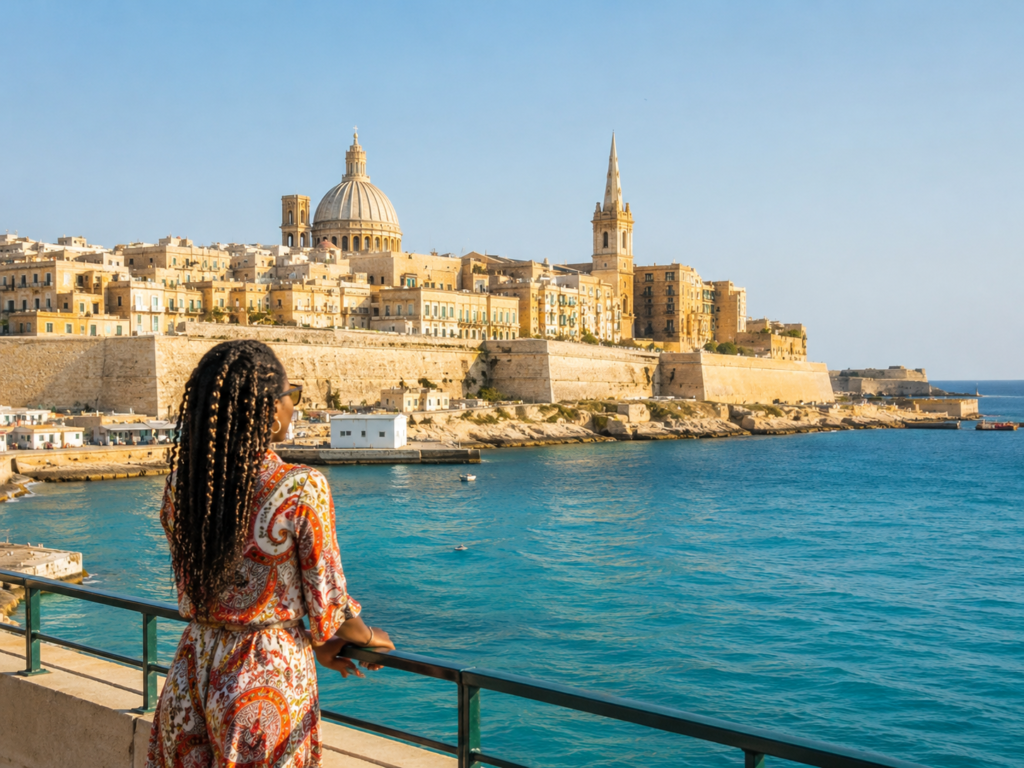
Why Malta Is a Unique European Destination
Malta is the smallest country in the European Union – a trio of islands in the heart of the Mediterranean Sea. It is an English-speaking nation, making it particularly accessible to Nigerian travellers. Malta’s ancient history, UNESCO World Heritage sites, warm climate, and stunning coastline make it a favourite for both tourists and business travellers. It is also a growing hub for gaming, financial services, and maritime industries.
As a Schengen member, a Malta visa grants access to all 29 Schengen countries.
What Is the Malta Schengen Visa?
A Malta Schengen visa is a short-stay authorisation that permits Nigerian passport holders to enter Malta and all 27 Schengen Area member countries for up to 90 days within any 180-day period. It covers tourism, family visits, and business travel. The standard adult fee is €80. As Malta has no resident embassy in Nigeria, applications are typically processed through a designated partner embassy, often Italy, which represents Malta for consular purposes in many countries.
Malta’s Schengen membership means a single approved visa covers not just the island itself but the entirety of continental Europe — a powerful document for any Nigerian traveller planning a broader European itinerary.
Types of Malta Visa Available for Nigerian Applicants
Malta is a full Schengen member, meaning your entry document is a Schengen visa — the same approval that opens Malta opens 27 European countries for the duration of its validity.
Schengen Type C — Short Stay
For visits up to 90 days within any 180-day window. Tourism, family visits, business travel, conference attendance, medical appointments, short academic programmes — all Type C. Available as single, double, or multiple-entry depending on your travel history and the consular officer’s assessment. This is the relevant category for the majority of Nigerian applicants.
National Long-Stay Visa (Type D)
For stays exceeding 90 days — enrolled students, workers on formal assignment, those beginning residency processes. Significantly more complex documentation required. This guide addresses Type C.
Where to Apply for a Malta Schengen Visa in Nigeria
Malta does not maintain a resident embassy in Nigeria. Consular representation for Malta is typically handled by a designated partner, most commonly the Embassy of Italy in Abuja, as Italy frequently represents Malta for visa purposes in countries where Malta has no embassy.
However, this arrangement is subject to change and must be confirmed before you begin your application.
Before preparing any documents:
- Visit the official Maltese Ministry of Foreign Affairs website (foreign.gov.mt) for the current designated submission point for Nigerian applicants
- Contact the Italian Embassy in Abuja to confirm whether they are currently handling Malta visa applications from Nigeria
- Or contact Mr Schengen Visa, we verify this for you and handle the logistics
Submitting to the wrong embassy is a common and entirely avoidable mistake that costs time and money.
Malta Schengen Visa Requirements for Nigerian Applicants
Core Documents (All Applicants)
- Valid Nigerian international passport — Minimum 3 months validity beyond your planned return date; minimum 2 blank visa pages; must be in good condition (no significant damage, loose pages, or water damage)
- Completed Schengen visa application form — Every field filled accurately, signed and dated; obtain the current version from the relevant embassy
- 2 recent passport photographs — 35×45mm, white background, neutral expression, no glasses; taken within the last 6 months
- Travel health insurance — Minimum €30,000 Schengen-wide coverage for your full trip duration; from a recognised international insurer; the policy document must state the coverage amount clearly
- Return flight reservation — Your full name, departure and return dates, full routing; a booking reservation is sufficient — do not purchase a non-refundable ticket before approval
- Proof of accommodation — Hotel booking confirmation (all nights), or a notarised invitation letter with your host’s proof of Maltese address and residency
- Bank statements — Last 3–6 months, all pages, certified or stamped by your bank; demonstrating consistent income and sufficient funds accessible during your trip
- Cover letter — A clear, personal letter explaining your purpose of travel, specific destinations and activities in Malta, your travel dates, and a genuine explanation of why you will return to Nigeria after your visit
- Proof of employment or business — Employment letter on company letterhead stating your position, monthly salary, and dates of approved leave; plus 3 months’ recent payslips; or for business owners: CAC documents, tax clearance certificate, and active business evidence
For Tourist Applicants — Also Include
- Day-by-day itinerary (which areas of Malta, which attractions, what you’re doing on each day)
- Evidence of ties to Nigeria (property, dependent family, ongoing employment contract)
For Visit (Family/Friends) Applicants — Also Include
- Notarised invitation letter from your Maltese host
- Host’s proof of Maltese residency or citizenship (ID card, residence document, or Maltese passport)
- Financial sponsorship affidavit and your host’s bank statements (if they are funding your stay)
For Business Applicants — Also Include
- Official invitation letter from a Maltese company or conference organisers (signed, stamped, on headed paper)
- Maltese company’s registration documents
- Nigerian company registration (CAC extract)
- Conference or event registration confirmation (if attending a specific event)
How to Apply for Your Malta Schengen Visa: Step by Step
Step 1 — Confirm your submission point
Check foreign.gov.mt or contact Mr Schengen Visa to identify the current designated embassy for Maltese visa applications from Nigeria.
Step 2 — Prepare your document pack
Collect originals and one copy of every document. Arrange them neatly in the order requested by the embassy. A clean, well-organised pack signals care and seriousness.
Step 3 — Complete the application form
Fill in every field. Inconsistencies between your form and your supporting documents — even small ones like name variations — can trigger additional queries or refusals.
Step 4 — Book your appointment
Contact the designated embassy and schedule your submission slot. Allow at least 8–10 weeks before travel given the indirect nature of the application process.
Step 5 — Attend, provide biometrics, and pay
Bring all documents to your appointment. Biometric data (fingerprints and photograph) will be collected if you are a first-time Schengen applicant or if your biometrics have expired.
Visa fees:
- Adults: €80
- Children aged 6–12: €40
- Children under 6: Free
- Additional embassy service charges may apply
Step 6 — Track and collect
Standard processing takes 10–15 working days from submission. Collect your passport at the embassy or by secure courier if that option is available.
Financial Requirements for a Malta Schengen Visa
Malta is more affordable than many Schengen destinations – accommodation, food, and transport cost notably less than in countries like Switzerland, Norway, or even France. This makes it attractive for Nigerian travellers who want to explore Europe without the most extreme costs.
Financial benchmarks for Malta:
- Show an accessible bank balance of €60–€100 per day of your intended stay
- Regular monthly income credited to your account
- No large unexplained cash deposits in the weeks before applying
- Account history spanning at least 3–6 months
For a 7-day trip to Malta, demonstrating €420–€700 in accessible funds is a solid baseline. Showing comfortably more strengthens your application without any downside.
What to See in Malta: Building a Genuinely Compelling Itinerary
The more specific and believable your itinerary, the stronger your application. Here’s what a well-rounded Maltese trip looks like:
Malta Island
- Valletta — Europe’s smallest capital city and a UNESCO World Heritage Site; St John’s Co-Cathedral, the Grandmaster’s Palace, and spectacular harbour views
- Mdina — The “Silent City”; a walled medieval capital perched on a hilltop; walk its narrow limestone streets for a genuine step back in time
- Blue Grotto — A famous sea cave complex on Malta’s southern coast; best seen by boat in the morning light
- St Peter’s Pool — A natural swimming pool carved into limestone cliffs; one of Malta’s most dramatic spots
- Marsaxlokk — A fishing village famous for its Sunday market and traditional luzzu fishing boats painted in brilliant colours
Gozo (Malta’s Smaller Sister Island)
- Azure Window Cliffs — Though the arch itself fell in 2017, the dramatic coastline remains extraordinary
- Ggantija Temples — 5,500-year-old megalithic temples; older than Stonehenge and the Egyptian pyramids
- Victoria (Rabat) — Gozo’s capital; the hilltop citadel offers panoramic views across the entire island
- Ramla Bay — Gozo’s finest beach; a long stretch of reddish-gold sand
A 7-day itinerary covering Valletta, Mdina, a day trip to Gozo, and Malta’s southern coast is specific, credible, and rich enough to support a strong visa application.
Why Malta Is an Excellent First Schengen Destination for Nigerians
Malta offers several advantages that make it particularly well-suited to Nigerian first-time Schengen applicants:
- English is an official language — No language barrier for Nigerian visitors; navigating daily life, transport, and services is effortless
- Warm climate year-round — Malta averages 300 days of sunshine annually; it is one of the Mediterranean’s warmest and sunniest destinations
- Compact and easy to navigate — The entire island is roughly 27km long; everything is accessible by bus, rental car, or taxi
- Rich history — From Neolithic temples to Knights of St John fortifications, Malta’s layered history is extraordinary per square kilometre
- Affordable by European standards — Meals, accommodation, and transport cost significantly less than in Western European capitals
- Strong air connections — Malta International Airport connects directly to major European hubs including London, Rome, Frankfurt, Amsterdam, and Paris, making it easy to combine Malta with other Schengen destinations
Malta Delivers More Than You Expect
Malta is the kind of destination that converts first-time visitors into repeat visitors. Its history is extraordinary, its landscapes are dramatic, its people are warm, and its English-speaking environment removes the friction that many Nigerian travellers worry about in other European countries.
Your Malta visa is your entry point to this island and to the entire Schengen zone. Getting the application right is the difference between setting foot on those limestone streets and watching someone else’s Instagram from home.
At Mr Schengen Visa, we understand exactly what the Italian Embassy (and other designated processing centres) need to see from Nigerian applicants. We review every document, refine every cover letter, and make sure your file is as strong as it can possibly be before submission.
Frequently Asked Questions: Malta Schengen Visa from Nigeria
Which embassy handles Malta visa applications for Nigerian applicants?
How long does Malta visa processing take from Nigeria?
Is Malta a good country for a first-time Schengen visa application from Nigeria?
Can I visit Italy and Greece on my Malta Schengen visa?
What is the best time to visit Malta from Nigeria?
Can I study English in Malta on a tourist Schengen visa?
Your Malta Adventure Starts with One Step
Valletta is one of the most beautiful cities you’ve never been to. Let’s change that.
Don’t risk a refusal on a technicality. Our experts at Mr Schengen Visa have helped hundreds of Nigerian applicants get their Schengen visas approved and we’re ready to help you too.
Let us take the stress out of your visa application. Book a Free Consultation |
  Download Your Malta Visa Checklist
Address: KM 4 Gbongan – Ibadan Rd, opposite Sterling Bank, Osogbo 230284, Osun, Nigeria.
Phone: +234 816 237 7613 | Email: mrschengenvisa@gmail.com